
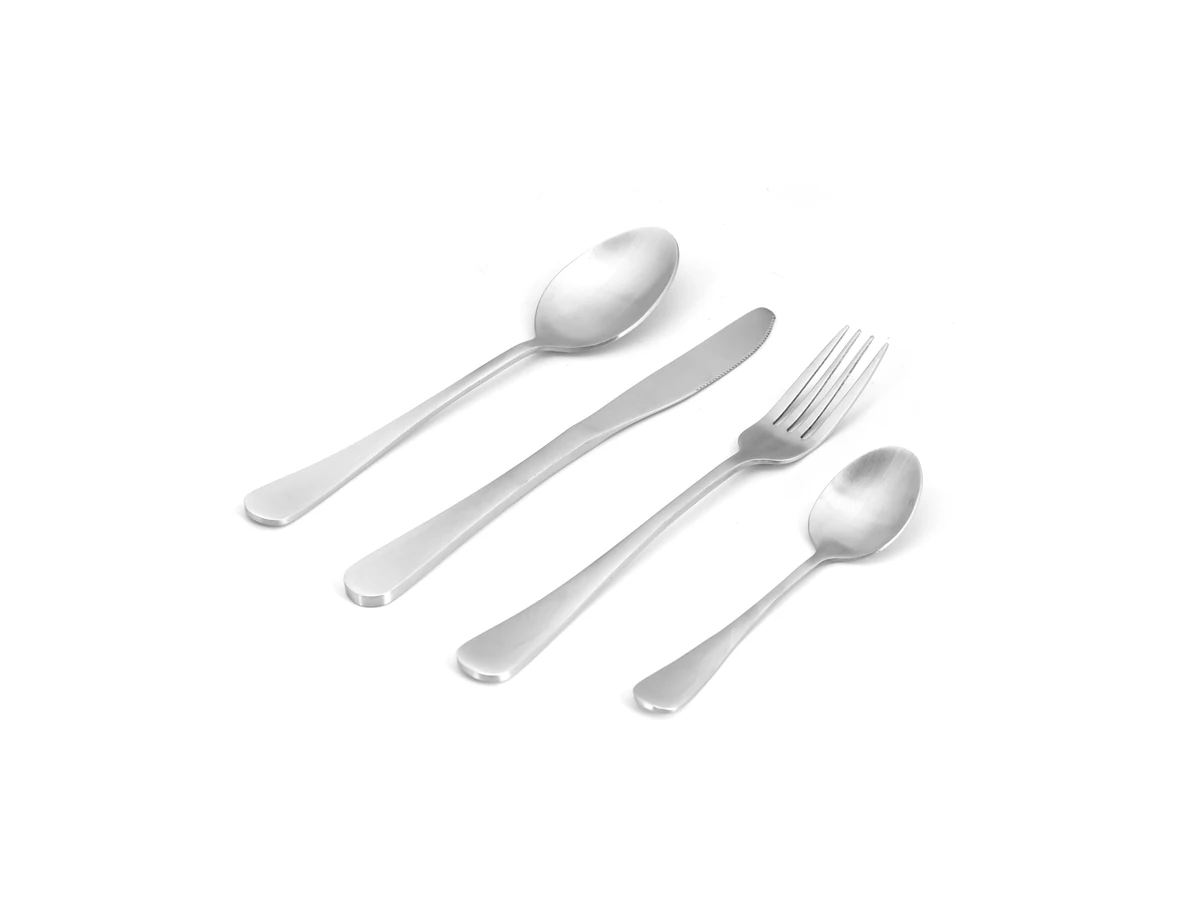
Flatware quotations arrive as piece lists, and piece lists only make sense if you know how a western place setting is built. Buyers who cannot map a piece name to a course end up ordering a service that looks complete on paper and fails in service — typically short of dessert forks and long on soup spoons.
This guide maps the western place setting from the buyer's side: what each piece is for, how a formal setting differs from a casual one, and what each channel actually stocks. The full product line referenced here is our western tableware collection.
Why the Piece List Starts with the Menu
A place setting is derived from the menu, not from tradition. Each course that requires an implement adds a piece; each piece placed on the table adds a position. That is why a steakhouse and a fish restaurant can buy from the same supplier and end up with quite different piece lists — the menu, not the price point, decides the inventory.
The Core Five and What They Do
| Piece | Function | Common specification note |
|---|---|---|
| Dinner fork | Main course | Longest fork; tine length matched to the plate |
| Dinner knife | Main course | Blade profile differs for steak and for general dining |
| Soup spoon | Soup and liquids | Round bowl; capacity affects portion perception |
| Teaspoon | Beverage and dessert | Smallest spoon in the set; most frequently lost |
| Salad or dessert fork | Starter, salad or dessert | Shorter than the dinner fork; often the second fork |
These five form the working core of nearly every service. The piece-count arithmetic that turns them into 16, 20 and 24-piece sets is covered in our flatware set composition guide.
Adding Course-Specific Pieces
Beyond the core, pieces are added against named courses. A fish course adds a fish knife and fork with a distinct blade and tine shape. A steak course adds a steak knife, usually with a serrated or micro-serrated edge. Dessert adds a dessert spoon and often a dessert fork. Oyster, snail and butter pieces are specialist items and should be bought only when the menu calls for them, because they carry their own replacement exposure.
Formal vs Casual Settings
A formal setting places pieces in course order from the outside in, with no more than three implements on each side of the plate, and it is built for a menu that has been fixed in advance. A casual setting is a subset: one fork, one knife, one spoon, with additional pieces brought out with the course. Most hospitality operations in daily service run the casual configuration and keep formal pieces for events — which is why banquet and à la carte inventories diverge even inside one property.
What Buyers Actually Stock
Stocking follows service pattern, not the full setting diagram. A restaurant running à la carte typically holds more dinner forks than any other piece, because forks are the piece that runs short first. A banquet operation holds proportionally more dessert and salad pieces, because its menus are course-heavy. A retail channel stocks by box configuration rather than by piece, and therefore cares about piece-count credibility more than about per-piece depth.
For how total quantities are calculated, including breakage and loss factors, see restaurant flatware par levels and the wider commercial flatware buying guide.
Reading a Piece List on a Quotation
When a quotation arrives, check four things against the menu: that every course has an implement, that piece lengths within a setting are consistent in style, that the finish is specified once rather than implied per line, and that service pieces are quoted separately rather than assumed. A quotation that lists "flatware set" without a piece breakdown cannot be compared with one that does.
Our western tableware range is organised by piece and by design family, so a buyer can assemble a setting from named pieces and confirm grade, unit weight and packaging per item before committing to a volume order.