
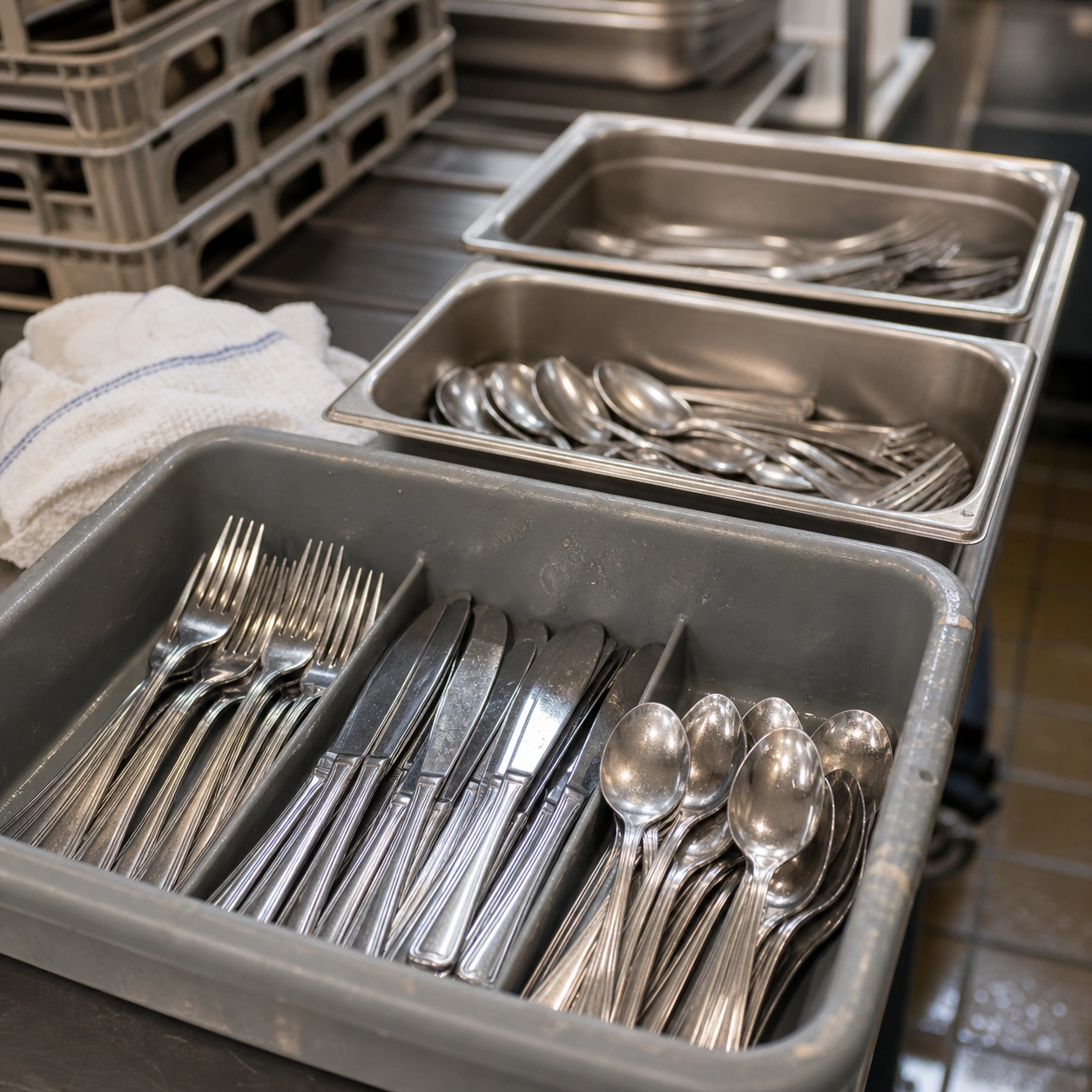
Restaurant flatware par levels should be calculated from peak simultaneous use, the time pieces remain unavailable in the dishroom, documented loss and damage, and replenishment lead time. A universal rule such as three pieces per seat may be a starting estimate, but it cannot account for menu, service style, table turns, warewashing flow, or pattern availability. This guide gives U.S. restaurant operators and hospitality buyers a method they can update with their own operating data.
Calculate Each Flatware Item Separately
A restaurant does not consume dinner forks, teaspoons, steak knives, and soup spoons at the same rate. Build the par for each item using this structure:
Target par = peak concurrent use + pieces unavailable during the wash-and-return cycle + replenishment reserve + unopened contingency stock
The first two terms support service. The third protects against loss, damage, and supplier lead time. The fourth is a management decision for openings, events, or supply interruptions. Do not mix those purposes in one unexplained multiplier.
Count on-hand inventory in the same unit used for purchasing. If dinner forks are ordered by dozen, keep the operational count by piece but convert the final reorder quantity to full case packs and order multiples.
Map Flatware Use by Menu and Service Period
Start with the menu, not the seat count. Record the default place setting, utensils added by entrée or course, bar and dessert service, banquet settings, room service, patio service, and utensils used by the kitchen or staff meal program.
| Operating question | Data to collect | Why it changes par |
|---|---|---|
| What is preset? | Pieces placed before the guest orders | Preset pieces are tied up for the entire seating |
| What is menu-triggered? | Steak knives, soup spoons, dessert forks, seafood pieces, and serving utensils | Usage depends on the sales mix, not total covers alone |
| What leaves the dining room? | Takeout, room service, catering, and outdoor service | Return timing and loss rates may be different |
| What is shared? | Serving spoons, cake servers, butter knives, and banquet utensils | Shared pieces need a station or event-based count |
| When does demand peak? | Highest concurrent covers by 15- or 30-minute interval | Daily covers can hide a short, severe service peak |
Use point-of-sale sales mix and host counts where available, then confirm the result by observing an actual peak shift. Staff often identify hidden uses that purchasing data misses, such as teaspoons used at the bar or dinner knives used for prep.
Measure the Full Dishroom Cycle
Warewashing time is not only the machine cycle. Measure from the moment a piece leaves the table until it is sorted, racked, washed, dried, inspected, returned to the station, and ready to reset.
- Choose the busiest representative service period.
- Mark or count a known batch of each flatware item as it enters the bussing flow.
- Record the elapsed time until the batch returns clean to the service station.
- Note delays caused by soaking, sorting, rack availability, staffing, rewashing, or cooling.
- Repeat the observation on more than one shift before setting the planning value.
Calculate how many additional pieces are consumed during that unavailable period. If 80 dinner forks are used while the previous batch is still moving through the full cycle, those 80 belong in the operating par even when the dining room has fewer than 80 seats.
The U.S. FDA Food Code describes multiuse utensils as durable, corrosion-resistant, substantial enough for repeated warewashing, and finished with smooth, easily cleanable surfaces. Those principles are useful in sample selection, though the Food Code is a model used by regulatory jurisdictions rather than a flatware product certification. See FDA Food Code 2022, section 4-101.11.
Use Actual Loss and Lead-Time Data for the Replacement Reserve
Loss includes accidental disposal, pieces leaving with takeout or room service, theft, and unexplained count variance. Damage includes bent tines, edge damage, severe scratching, coating failure, and pieces removed for sanitation or appearance standards.
Run a cycle count by item at a consistent interval. Record receipts, transfers, disposals, and event issues. After enough periods, calculate the average and high-case net loss for each item rather than applying one percentage to the whole pattern.
A practical reorder point is:
Reorder point = service operating par + expected loss during confirmed replenishment lead time + receiving and inspection buffer
Lead time should run from purchase-order release to inspected, usable stock at the operation. If the pattern is imported or custom, include sample or artwork approval when repeat orders may require it. If the supplier stocks the pattern domestically, use the actual fill-rate and transit record rather than the quoted best case.
Illustrative Scenario: A Restaurant With an Unbalanced Inventory
Consider a hypothetical full-service restaurant that has enough dinner forks for opening but repeatedly runs short of teaspoons during weekend brunch. The purchasing team originally used the same per-seat multiplier for every item.
Observation shows that teaspoons serve coffee, tea, desserts, and bar garnishes, and many remain in bus tubs longer than dinner forks. The solution is not to raise every flatware quantity. The operator increases the teaspoon operating par based on measured peak use and dishroom delay, creates a separate bar count, and leaves the dinner-fork par unchanged.
This scenario is illustrative, not a customer case or a recommended multiplier. Its value is the method: identify the item, locate the bottleneck, and correct that item’s par instead of buying an entire pattern indiscriminately.
Choose a Flatware Pattern That Can Be Replenished
Appearance and hand feel matter, but replacement continuity is an operating specification. Ask how long the pattern has been produced, whether individual pieces can be reordered, what the reorder MOQ is, and whether the factory retains tooling and approved finish standards.
| Use case | Selection priority | Question for the supplier |
|---|---|---|
| High-turn casual dining | Smooth edges, repeatable finish, efficient sorting, and economical replacement | Can individual pieces be reordered in practical case packs? |
| Fine dining | Balance, proportion, finish consistency, and complete place-setting range | How will repeat lots be matched to the approved finish sample? |
| Banquet and catering | Large-count handling, stackability, transport protection, and fast counting | What bulk-pack and storage-tray options reduce contact damage? |
| Multi-unit group | Specification control, central reserve, and repeat-order consistency | Can the supplier maintain the revision, tooling, and packaging data for later orders? |
Review samples with both operations and design teams. Our flatware sample inspection checklist provides measurable checks beyond style and weight. For a broader product decision, see the existing restaurant and hotel tableware selection guide.
Common Flatware Inventory Mistakes
- Applying one pieces-per-seat number to every item.
- Using daily covers instead of peak concurrent demand.
- Timing the dishmachine but not bussing, sorting, drying, inspection, and return.
- Combining loss, damage, operating stock, and emergency reserve in one unexplained par.
- Buying custom patterns without confirming individual-piece reorder options.
- Keeping reserve stock in open circulation, where it disappears before an emergency.
- Counting sets instead of individual pieces during cycle counts.
- Ignoring bar, room service, catering, patio, and staff-use inventory.
FAQ
Is three pieces per seat enough?
It may be enough for one operation and inadequate for another. Use it only as a temporary estimate until you measure peak use, the full wash-and-return cycle, and loss during replenishment lead time.
How often should a restaurant count flatware?
Count often enough to identify loss before it becomes a service problem. New openings, events, and high-loss operations may need frequent counts; stable operations can adjust after they establish a reliable trend. Keep the day, time, and counting method consistent.
Should emergency reserve be included in station stock?
No. Store and label contingency stock separately, assign access responsibility, and define the event that releases it. Otherwise the reserve becomes normal operating stock without management noticing.
How should a multi-location group handle replacements?
Use one controlled specification, maintain a central record of approved samples and revisions, and consider a shared reserve for slower-moving pieces. Track loss by location so one unit’s operating problem does not distort group purchasing.
Build the Opening Order From Your Service Flow
A defensible restaurant flatware par level explains why every quantity is needed: service demand, wash-cycle delay, replacement coverage, or contingency. Once those elements are separated, the operator can change one input without replacing the entire inventory plan.
If you are planning an opening or pattern change, send us the seat count, service style, default place setting, menu-specific pieces, expected peak covers, measured wash-and-return time, target finish, and replacement strategy. We can help convert that operating brief into a piece-by-piece quotation and packaging plan; final quantities remain subject to your own service data.