
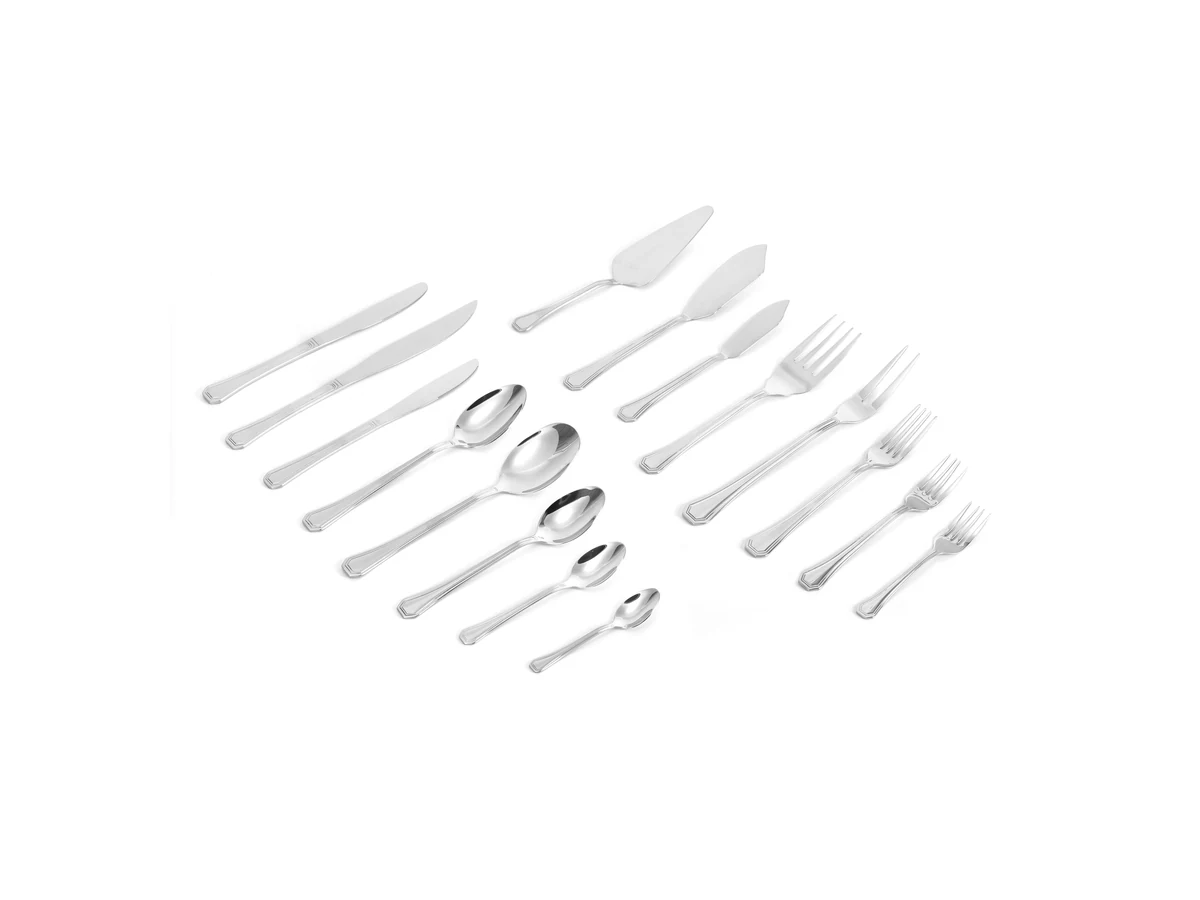
Two suppliers can quote the same unit price for a "20-piece flatware set" and deliver two completely different products. Piece count is a marketing number, not a specification. What actually determines whether a set sells through, or arrives short of teaspoons in a restaurant, is the composition — how many place settings the box contains, which items sit in each setting, and which serving pieces come with it.
This guide explains how flatware set configurations are counted, how the same eight items get shuffled into 16-, 20-, 24- and 45-piece boxes for different channels, and how to write a composition that a factory can quote and a buyer can audit.
In this article
What a piece count actually means
A flatware set is quoted in total pieces, but the number tells you nothing on its own. A 24-piece set can be six place settings of four items, or four place settings of six. A 16-piece set can be four settings of four, or two settings of eight. Both statements are true, and only one of them will match what your customer expects.
Three numbers matter, always in this order:
- Number of place settings. The people the set serves at one sitting.
- Items per place setting. Usually four, five or six, and which items they are.
- Serving pieces included. Counted in the total, but not part of any place setting.
Write it as 6 × 4 + 3 or 4 × 5 + 5 rather than "24-piece", and the ambiguity disappears. This convention belongs in every quotation, sample approval and purchase order.
The five-piece place setting and its variants
The North American standard place setting contains five items. Remove one and you have the value configuration; add one and you have the formal one.
| Place setting | Items | Where it is used |
|---|---|---|
| Three-piece | Dinner fork, dinner knife, teaspoon | Entry price points, starter sets, budget retail |
| Four-piece | Dinner fork, salad fork, dinner knife, teaspoon (or soup spoon) | Value boxed sets, supermarket programmes |
| Five-piece | Dinner fork, salad fork, dinner knife, soup spoon, teaspoon | The North American default for retail and gifting |
| Six-piece | Five-piece plus steak knife or dessert spoon | Premium retail, continental European service |
European sets follow the same logic with different accents. The individual items change — a dessert spoon and dessert fork, a coffee spoon alongside the teaspoon, a fish knife and fork in formal continental patterns — but the rule is identical: the set is defined by which items make up a setting, not by the number on the box.
Standard configurations by market and channel
These are the compositions buyers most often ask a factory to build. They are not rules, but they are what the market expects, and deviating without a reason costs sell-through.
| Configuration | Typical composition | Channel |
|---|---|---|
| 12-piece | 4 × 3 | First-home, student, promotional |
| 16-piece | 4 × 4 | Supermarket, discount retail, e-commerce entry SKU |
| 20-piece | 4 × 5 | Department store, gifting, the mainstream retail default |
| 24-piece | 6 × 4, sometimes 4 × 6 | Family retail; specify which reading you mean |
| 45-piece | 8 × 5 + 5 serving pieces | Wedding and housewarming gift sets, premium retail |
| Bulk foodservice | Single items by the dozen, no box | Restaurants, hotels, catering, contract supply |
Note the last row. Hospitality buyers rarely purchase "sets" at all — they buy each item separately by the dozen, because replacement demand is per item, not per setting. If you sell to both retail and foodservice, plan the composition for both: one boxed configuration for retail, and a per-item ordering structure with the same pattern, weight and finish so the two channels stay visually consistent.
Serving pieces decide the perceived value
At a given price, serving pieces are the cheapest way to make a box feel generous — and the easiest place to be accused of padding it. Two principles keep the set credible.
- Match serving pieces to the cooking culture you are selling into. A gravy ladle and meat fork belong in a set aimed at traditional roast dinners. A slotted serving spoon and salad servers suit lighter, vegetable-led menus.
- Do not inflate the count with duplicate place items. Adding four extra teaspoons to reach the next round number is transparent to the customer the moment the box is open, and it damages repeat purchase more than a lower piece count would.
A practical serving assortment to choose from: solid serving spoon, slotted or pierced serving spoon, serving fork, salad fork-and-spoon pair, gravy or sauce ladle, sugar spoon, butter knife, cake server, cake fork, and steak knives. Steak knives are the one item that usually breaks the material rule — the blade needs a harder, more corrosion-resistant grade than the handle or the rest of the set, so confirm the blade specification separately rather than assuming it matches the forks.
Getting the item ratios right
Composition is not only about which items, but how many of each. Getting the ratio wrong shows up months later as a stock problem.
| Situation | What goes wrong | What to do instead |
|---|---|---|
| Restaurant order in sets | Forks wear out or disappear faster than knives; half the set becomes dead stock | Order by item, with extra forks and teaspoons as the two highest-turn replacements |
| Retail set with too few teaspoons | Customer complaints; teaspoons are the most-used item in a household | One teaspoon per setting minimum, two in premium configurations |
| Mixed grades across the set | Forks and spoons look duller than knives, or tarnish at different rates | Hold one grade and one thickness across the place items; deviate only for the knife blade, and state why |
| Serving pieces from a different pattern | The set photographs well and looks mismatched on the table | Tool serving pieces from the same handle pattern wherever the shapes allow |
How to write the composition into a purchase order
A composition that is unambiguous in writing prevents most short-shipment and chargeback disputes. Include all of the following:
- Setting count and items per setting, written as 6 × 4 + 3.
- Full item list with quantities for the whole box, not just the arithmetic.
- Material grade and thickness per item, including the knife blade if it differs.
- Finish for each item, and whether the serving pieces share it.
- Approved sample reference — the sample that defines the composition.
- Packaging layout: how each piece sits in the box or tray, and whether any item is bagged separately.
- Carton quantity and how many boxes per carton, plus gross weight and carton dimensions.
- Tolerance on count. Flatware counts should be exact, not "approximately"; state a zero-shortage requirement and the remedy if it is missed.
Finally, keep the composition stable across reorders. A supplier that quietly changes the teaspoon count, substitutes a lighter gauge in the serving spoon, or re-sources the steak knife blade is changing your product, and you will be the one explaining it to the customer.
Frequently asked questions
What is the difference between a 20-piece and a 24-piece set?
Usually the setting count, not the setting size. A 20-piece set is normally four settings of five; a 24-piece set is normally six settings of four. Because both readings circulate in the market, always confirm in writing which one you are buying — and never let a quotation use the piece count alone.
How many teaspoons should a set include?
One per place setting is the minimum that feels complete, and two per setting is common in premium and gift configurations. Teaspoons are the item most likely to be reported missing by end customers, so under-supplying them to lift another item's count is a false economy.
Should the knife blade be the same steel as the set?
Not necessarily, and often it should not be. Knife blades are commonly made from a different, harder grade than forks and spoons because the edge has to hold up in use. Treat the blade as its own specification line and require the grade to be stated, rather than assuming the set is uniform.
Can I mix handle patterns within one set?
You can, and some brands do it deliberately as a design statement. But it has to be intentional: buyers who mix patterns accidentally end up with sets that look assembled from spare parts. If you want a mixed pattern, specify each item's pattern individually and approve an assembled sample of the complete set.
Do serving pieces need their own tooling?
Often yes. Ladles, cake servers and pierced spoons have geometry that cannot be produced from the tooling used for forks and spoons, so they carry separate development cost. Ask for serving-piece tooling to be quoted explicitly rather than absorbed into a vague per-set price, so you know what you are paying for and what you own.
Composition is the part of a flatware programme that costs nothing to get right at the quotation stage and a great deal to fix later. Define the setting, name every item, and hold the ratios constant across reorders — the box in the customer's hands then matches the one in your specification.