
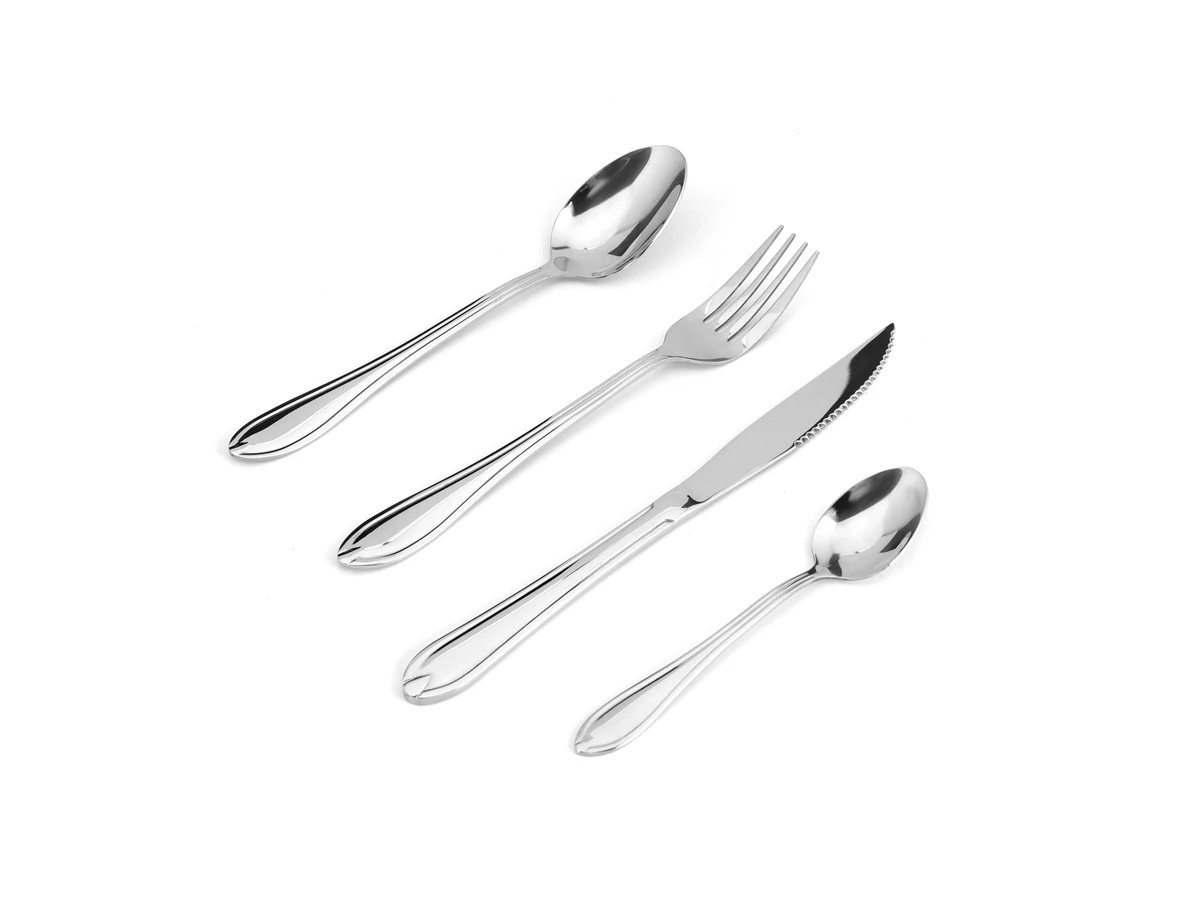
An open handle is a design statement that doubles as an engineering problem. Removing material from the handle reduces weight and changes the way load travels from the bowl to the hand. Buyers who choose an openwork pattern on appearance alone sometimes discover the consequence six months into service, when the loop bends or the inner edge feels rough.
This article explains how open handles are produced, where rigidity comes from, and what to write into a specification so the design survives commercial dishwashing. The range used as reference is our open handle flatware collection. For the wider comparison of handle constructions — solid, hollow, weighted and open stem — see our handle architecture guide.
What "Open Handle" Means in Production Terms
In production, an open handle is a handle where material has been removed to create a void: a loop, a teardrop, a cutout pattern or an openwork ornament. The void is created either by piercing a blank with a die, by stamping the profile from a wider blank, or — for heavier constructions — by casting or by welding a formed frame to the bowl end. Each method leaves a different edge and a different strength profile.
Piercing and Cutout Options
Piercing is the most common route. A hardened die punches the void out of a pressed blank, then the cut edge is debossed and polished so that it does not read as a sharp rim. The practical limits are the ones buyers should ask about:
- Minimum web width — the metal left between the opening and the outside edge. Too thin a web distorts during polishing.
- Corner radius — square internal corners concentrate stress and are harder to finish cleanly than rounded ones.
- Void position — an opening placed close to the bowl end interrupts the load path more than one placed toward the handle end.
Cutout patterns with many small openings cost more than a single large loop, because every void needs die detail, edge finishing and inspection. That cost difference is legitimate and should be visible in a quotation rather than absorbed by reducing weight.
Where Rigidity Comes From
A handle does not need to be solid to be stiff. Rigidity comes from the section modulus of the remaining material: the shape of the web around the opening, the thickness of the blank, and the amount of formed curvature along the handle. A shallow U-form channel along a loop handle can make it noticeably stiffer than a flat loop of the same metal weight. This is why an experienced toolmaker asks about bend direction before finalising an openwork design.
Weight and balance are separate variables. An open handle usually moves the balance point toward the bowl, which changes how the piece feels rather than how strong it is. The relationship is covered in flatware weight and balance specification.
Edge Finishing Inside the Opening
The inside edge of a void is the part of an open handle that customers touch and the part that most often escapes inspection. It must be deburred, radiused and polished to the same standard as the outside profile. A simple field test: run a fingernail along the inside edge in both directions. Any catch means the piece will feel unfinished in use and will trap residue in the dishwasher.
Test Points Before Bulk Production
For open handle designs, add four checks to the standard sample approval:
| Check | Method | Acceptance |
|---|---|---|
| Bend resistance | Apply hand pressure in the normal carry direction | No permanent set; returns to shape |
| Inner edge | Fingernail test around the full opening | No burr, no catch |
| Web thickness | Measure at the thinnest point of the remaining metal | Matches the approved drawing |
| Surface continuity | Visual under raking light | No die marks or polishing shadow inside the void |
Run these on production samples, not on hand-finished prototypes. Prototypes are usually polished by hand and hide problems that appear when the piece is finished in a barrel or on a polishing line.
Care Instructions That Protect the Design
Openwork designs collect water in the void and dry more slowly than a solid handle. Two instructions prevent most complaints: load pieces so that the opening drains, and dry immediately after washing rather than leaving pieces to air-dry in a rack. If the item is used in a commercial washer, confirm that the detergent regime is appropriate for the steel grade — the same guidance as other stainless flatware applies, summarised in cleaning and polishing stainless steel flatware.
Our open handle flatware range is documented with the opening geometry, web width and finish per pattern so that a reorder can be matched to the approved sample rather than to a photograph.