
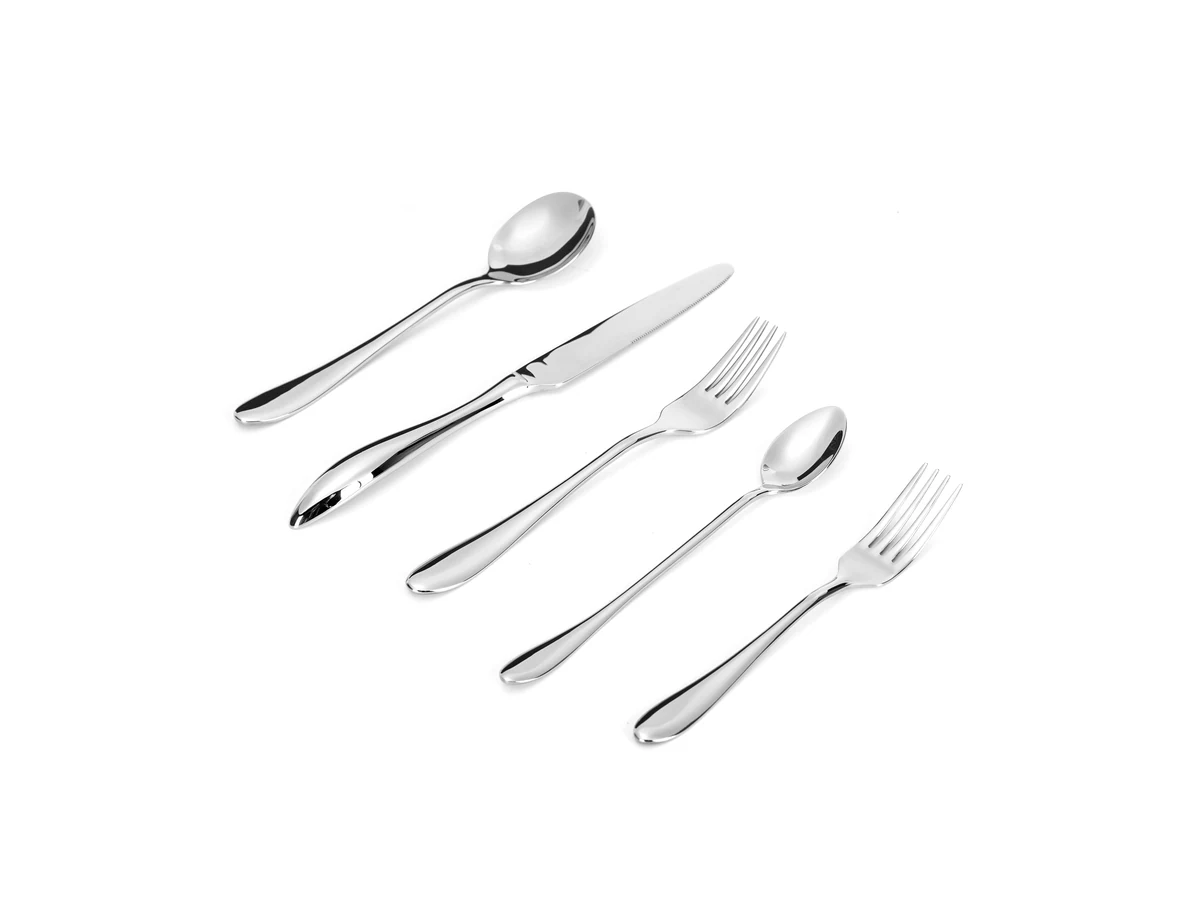
Weight is the first thing a customer notices about flatware and the last thing most specifications describe. A buyer will compare two 18/10 sets, find them 30 or 40 per cent apart in mass — and then discover that neither the grade label nor the finish name explains the difference. This article covers how weight and balance are actually set on a custom flatware programme, how to write them as numbers a factory can hold, and how to verify them at sample stage and again at bulk.
In this article
- Why weight belongs in the specification
- Gauge and thickness: what the number does not say
- Expressing weight in grams per piece
- Balance: the difference between heavy and well made
- Tolerance: how much variation is normal
- Writing weight and balance into a specification
- Verifying weight at sample and at bulk
- Frequently asked questions
Why weight belongs in the specification
Flatware is judged in the hand before it is judged on the table. A diner picks up a fork, feels its mass and balance, and forms a view about the whole setting without ever reading a specification. That judgement is the reason two sets made from the same steel grade at the same price point can sit at very different positions in a market.
The grade label does not settle the question. 18/10, 18/8 and 18/0 describe chromium and nickel content, which govern corrosion behaviour and the finish ceiling, not mass. Two sets can both be genuinely 18/10 and still be separated by a large difference in grams per piece, because weight is decided by gauge, by the amount of metal the handle carries and by how the handle is formed.
That produces a specific procurement problem. A buyer who specifies only grade and finish has left the most perceptible property of the product unspecified — and the factory will produce to the gauge that suits the price. The result is a set that matches the paperwork and disappoints in the hand.
Practical framing: write weight as a number with a band and a measurement method. Left unwritten, gauge and mass become a cost negotiation conducted on your behalf.
Gauge and thickness: what the number does not say
Gauge is the starting point for weight — and it is also the most frequently over-simplified specification in a flatware brief. A single gauge figure describes sheet thickness, but a finished piece does not have one thickness. The handle, the neck and the bowl or blade junction are formed from the same blank and end up measurably different after forming, rolling and trimming.
Three consequences matter commercially:
- Thickness at the handle is not thickness at the bowl. A brief that names one gauge leaves the distribution of metal to the tooling design, and different tooling designs produce noticeably different mass from the same blank.
- Gauge tolerances accumulate. Sheet arrives within its own allowance, forming takes up some of that variation and polish removes a little more, so two production runs of nominally identical pieces can differ in mass by a small but perceptible amount.
- Heavier gauge is not automatically better. Beyond a point, added mass is felt as clumsiness rather than quality, and it increases material cost, forming load and freight weight across the whole order.
This is why gauge alone is a weak specification — and grams per piece is a strong one. Gauge describes an input; weight describes what the customer receives.
Expressing weight in grams per piece
Weight is normally specified per piece, and the figure should be stated separately for each utensil rather than as an average for the set. A dinner fork, a teaspoon and a knife are different products with different targets, and a set-level average hides the piece that is wrong.
| What drives weight | Effect on the finished piece | Commercial consequence |
|---|---|---|
| Sheet gauge | Raises mass across the whole piece | Material cost per piece and total freight weight |
| Handle construction | Determines how much metal the handle carries and where it sits | Tooling design and forming steps, so it is fixed early |
| Handle length and section | Longer or broader handles add mass at the far end of the piece | Shifts balance as well as weight, and affects carton dimensions |
| Bowl or blade size | Adds mass at the working end | Perceived capacity, and for knives a separate steel specification |
| Finish removal | Heavier polishing removes slightly more metal | A small systematic difference between finish options |
The second row is the one that decides whether a weight target is achievable at a given price. Handle construction is a tooling decision — so a weight target raised after tooling is approved is generally a tooling change rather than an adjustment. Weight targets belong in the development brief, at the same time as the pattern.
Balance: the difference between heavy and well made
Balance is where two pieces of identical mass can feel entirely different. The balance point is the position along the piece at which it rests level on a fingertip or a narrow edge, and it is a consequence of where the metal sits rather than how much there is.
For flatware, balance expectations differ by utensil. A spoon tends to be judged with a full bowl, so the working end needs enough mass to feel controlled rather than top-heavy. A fork is judged in the hand and on the plate, where a handle that is too light at the far end feels insubstantial. A knife is a different object entirely, because the blade is a hardened steel component with its own specification, and the handle only has to feel continuous with it.
Two practical points about specifying balance:
- It is easier to describe by comparison than by number. A sentence of the form heavier in the handle than the sample, or lighter towards the bowl, is imprecise but it directs the tooling designer; a balance point stated as a distance from the handle end is measurable but only meaningful if the method of finding it is also stated.
- It is settled at first article, not at bulk. Balance follows from the formed geometry, so the first article is the moment to hold pieces in the hand and say so, while the tooling can still be adjusted.
Tolerance: how much variation is normal
A weight target without a tolerance band is not a specification — because no production process produces identical pieces. The band should be written per piece, and it should be wide enough to be producible and narrow enough to protect the perception of the set.
| Item | How to state the target | Measurement basis |
|---|---|---|
| Dinner fork | Nominal grams with an upper and lower limit | Individual piece on a calibrated scale, as finished and polished |
| Dinner spoon | Same structure, stated separately from the fork | Individual piece, not a set average |
| Teaspoon | Own band, since small pieces show percentage variation more visibly | Individual piece |
| Knife | Handle and blade mass considered together with the blade grade | Individual piece, with the blade material recorded separately |
| Set | Not specified as an average; derived from the per-piece bands | Sum of inspected pieces, for information only |
The set-level figure deserves emphasis. Specifying a set weight is attractive because it is easy to measure and easy to compare in a quotation, and it is exactly the wrong basis for inspection, because a set can hit its total while containing one piece that is well outside its individual band. Weight belongs at piece level, and the set figure follows from it.
Writing weight and balance into a specification
A usable weight specification contains five elements, and a brief missing any of them will be quoted on assumptions rather than on requirements:
- A target per piece, in grams, for every item in the range. Including serving pieces, which are heavier per piece and often forgotten.
- An acceptable band, stated per piece. Expressed as limits rather than as a vague instruction to keep it heavy.
- The measurement basis. Finished and polished, weighed individually, on a calibrated scale, with a stated sample size.
- A balance description, and a reference piece where possible. A physical sample settles balance arguments faster than any wording.
- A priority order. Where two requirements compete, say which wins: a slightly lighter piece with comfortable edges is usually a better outcome than a piece that hits its gram target with an edge that feels sharp.
Cost note: weight is one of the few specifications that changes the material bill directly. Raising a target across a large order increases steel consumption per piece, and it also increases the weight shipped, so freight is affected as well as unit cost.
Verifying weight at sample and at bulk
Weight is unusually easy to verify — which makes it worth verifying properly. A scale and a reference piece answer most questions in a few minutes, and they answer them before the goods are on a vessel rather than after.
- At sample stage, weigh every piece in the set individually and record the numbers rather than forming an impression. Sampling for a custom pattern typically runs 10–25 days depending on complexity, so the weight figures arrive before the tooling discussion is finished and can still influence it.
- Compare against the sealed reference, not against the target alone. A piece inside its band but consistently at the lower end is technically compliant and perceptibly lighter than the approved sample.
- Weigh a sample of finished goods at pre-shipment. A short check across cartons detects drift in gauge or forming while the goods are still in the factory.
- Record the numbers against the specification version. Weight data is only useful for the next order if it is filed with the version it belongs to.
Specifying weight and balance for a new pattern?
We develop flatware patterns and tooling at our Jieyang facility and supply sealed samples with measured weight per piece, so balance and mass can be agreed before tooling is finalised.
Frequently asked questions
Why do two 18/10 sets weigh so differently?
Because the grade describes chromium and nickel content, not mass. Weight is decided by sheet gauge, by how much metal the handle carries and by how the handle is formed, and none of those is fixed by an 18/10 label. Two suppliers can both supply genuine 18/10 flatware and ship sets that differ substantially in grams per piece, which is why weight should be written into the specification rather than inferred from the grade.
Should weight be specified per piece or per set?
Per piece, with the set figure derived from it. A set-level target is easy to quote against and a poor basis for inspection, because a set can reach its total weight while one item sits well outside its own band. Serving pieces and teaspoons are the items most often lost in a set average, and they are also the items where a difference is most noticeable in use.
Can a set be made heavier without new tooling?
Sometimes, and usually not by much. A modest change in gauge can be produced from existing tooling in some cases, but there is a limit to how much additional metal the forming tools will accommodate, and a larger increase generally means reworking the tooling. Where weight is a central part of the product positioning, the target belongs in the development brief alongside the pattern rather than as a change request after the first article.
Is heavier flatware always better?
No. Weight is one variable among several, and beyond a point additional mass reads as clumsy rather than substantial. Balance matters as much as mass: two pieces of identical weight can feel entirely different depending on where the metal sits. For hospitality programmes, weight also has to be sensible for the staff carrying trays of it all day, which is one reason commercial specifications tend to be lighter than premium retail ones.
How should weight be checked at inspection?
Individually, on finished and polished pieces, on a calibrated scale, against both the stated band and the sealed reference. Recording the actual numbers matters more than a pass or fail mark, because the figures show whether a shipment sits at the centre of its band or at the edge, and that tells a buyer what the next run is likely to look like. A set average is useful for information and should not be used as the acceptance criterion.
Weight and balance are the properties a customer feels before reading anything, and they are among the cheapest specifications to control: a target per piece, a band, a stated measurement method and a sealed reference. A brief that contains those four things is quoted more accurately, inspected more simply and repeated more faithfully than one that specifies only grade and finish.