
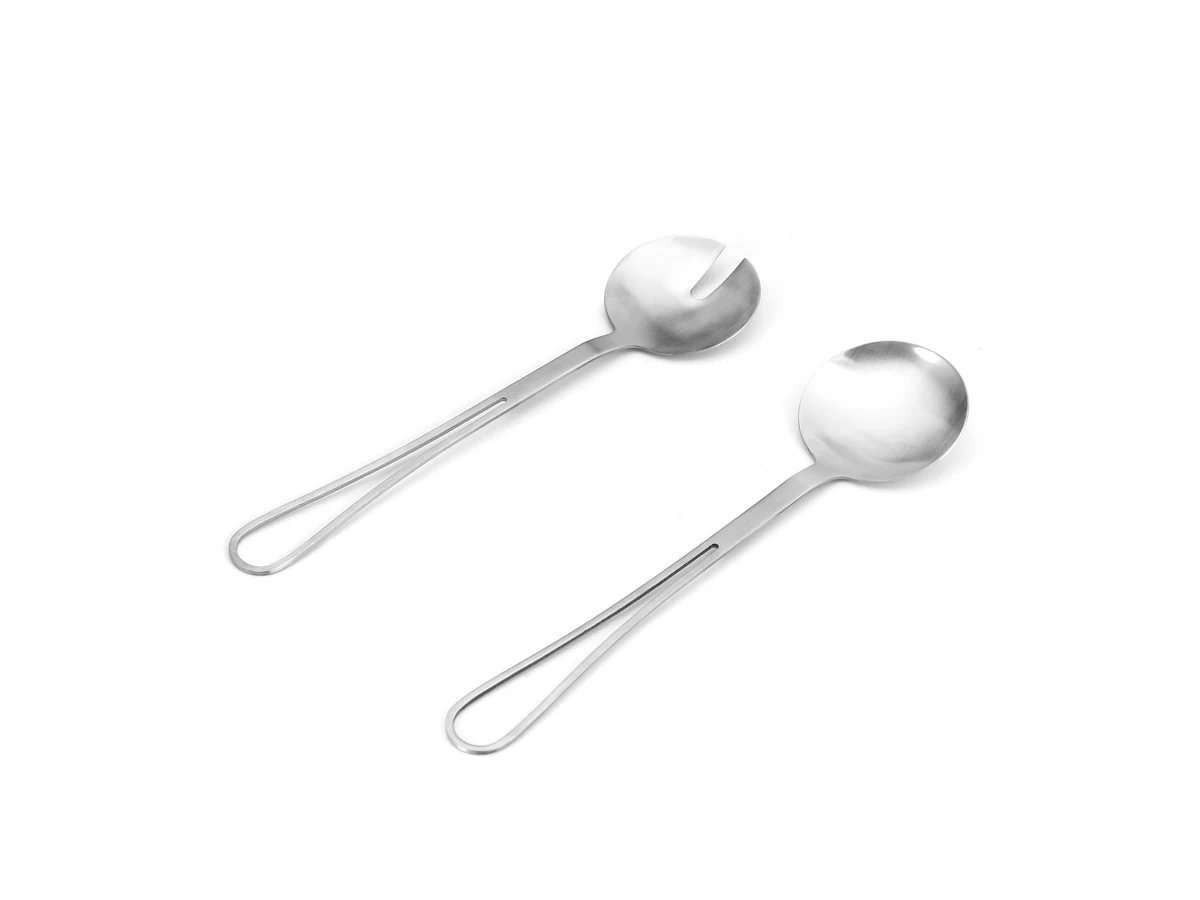
Every flatware program gets audited twice: once when the place settings are approved, and again in service, when a server cannot portion a dessert or lift a salad without the right piece. Serving utensils are where most specifications are thinnest. They are also the cheapest part of the order to get right.
This guide covers the pieces that belong in a complete program, how many to allocate relative to covers, the dimensions worth writing into a purchase order, and how to keep serving pieces visually matched to the place setting. The reference range is our stainless steel serving utensils collection.
Why Serving Pieces Get Left Out of the Specification
Place settings are easy to count — covers multiplied by pieces. Serving utensils do not scale that way, so they get estimated, and estimates tend to copy last year's order. The result is a program with adequate forks and inadequate ladles: buffet lines slow down, staff improvise with dessert spoons, and replacement orders arrive piecemeal at retail prices instead of at program pricing.
The Core Serving Piece List
A hospitality or catering program usually needs the following before it needs anything decorative:
- Serving spoon — solid bowl, for vegetables, rice and portioning from a hotel pan.
- Slotted or perforated serving spoon — for draining and for items served with liquid.
- Ladle — sauce, soup and gravy; bowl capacity is the specification that matters.
- Cake or pie server — flat blade with a tapered edge for lifted portions.
- Sugar or condiment spoon — small bowl, short handle, buffet and beverage service.
- Salad serving pair — spoon and fork, matched length for tossing and plating.
Beyond this core, add pieces only against a named service need: a buffet fork for carved meat, tongs for pastry, a sauce ladle with a pour lip. Every extra piece adds a replacement SKU that must be stocked for years.
Allocating Serving Pieces to Covers
There is no universal ratio, but there is a defensible starting method. Work from service points rather than from guest count: count how many buffet stations, carving points, dessert stations and sauce services the operation runs, then allocate one working piece per station plus one spare per shift. A 300-cover banquet hall with two buffet lines needs fewer ladles than a 120-cover restaurant running an à la carte sauce service all evening.
For how total piece quantities are calculated for restaurant operations, including loss and breakage factors, see restaurant flatware par levels. Serving pieces follow the same par logic with a smaller multiplier — they are handled less often but by staff, and they leave the building more rarely.
Specifying Length, Bowl Capacity and Handle
Three dimensions decide whether a serving piece works in service. Length determines reach and leverage from a hotel pan. Bowl capacity determines portion control — an undersized ladle silently inflates food cost, an oversized one creates waste. Handle shape determines grip when the piece is wet.
| Piece | Specify | Why it matters |
|---|---|---|
| Serving spoon | Overall length, bowl length and width, bowl depth | Portion size and pan reach |
| Ladle | Bowl capacity in ml, handle length | Portion cost control |
| Cake server | Blade length, blade width, edge profile | Clean release of soft desserts |
| Salad pair | Matched length, fork tine count | Tossing efficiency and presentation |
Material grade also deserves a decision. Serving pieces sit in wet, acidic environments longer than dinner forks, and they are the pieces most likely to pit if the grade is chosen on price alone. Our stainless steel grade comparison explains what 304, 430 and 201 mean in service rather than on a certificate.
Finish and Pattern Matching
Serving utensils are judged against the place setting, not on their own. If the place setting is mirror polished, a satin serving spoon looks like a substitution. If the pattern has a relief border, a plain serving piece reads as a cheaper line. Two practical rules: specify the same finish process and the same handle family as the place setting, and accept that a serving piece in a patterned line may need its own tooling to carry the pattern on a wider handle.
Where the pattern cannot be carried across, the honest option is a deliberately plain serving line in the same finish — consistent in surface, different in ornament — rather than a partial pattern that looks like a manufacturing error.
Care and Replacement Planning
Serving pieces are the first items to show water spotting because they are rinsed and left wet between stations. Specify dishwasher-safe construction, and brief the operator on drying. The cleaning limits for stainless flatware are covered in how to clean and polish stainless steel flatware.
Finally, set a replacement allowance per serving SKU. Unlike place settings, serving pieces fail one at a time, and a program that cannot reorder a single ladle style will end up with mismatched service within a year. Our serving utensils range is documented piece by piece so that a reorder can name the exact item rather than describing it from memory.