
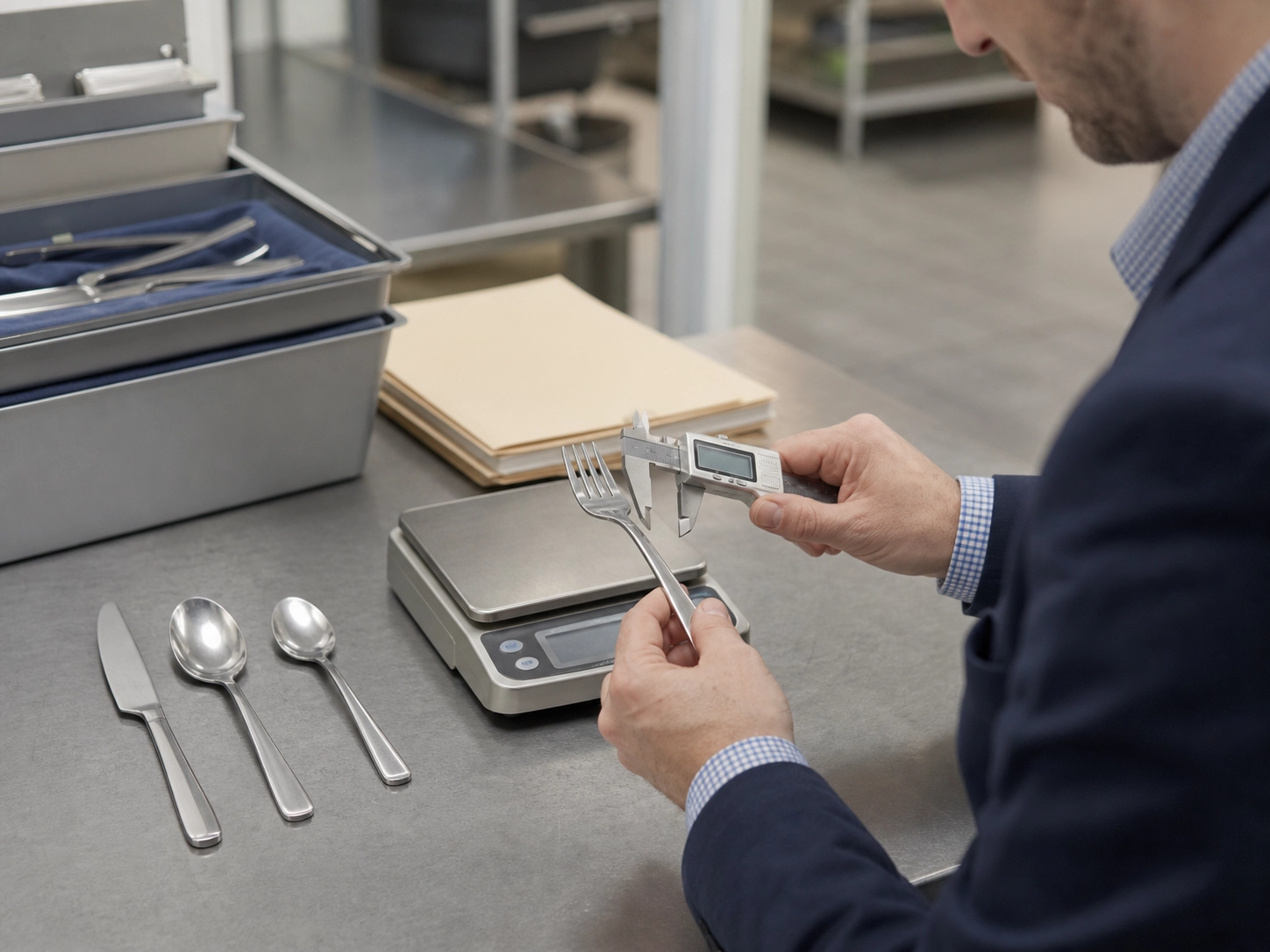
Two flatware sets can carry the same steel grade, the same piece count and the same price, yet perform completely differently in a customer's hand. The difference is almost always the handle architecture — how the stem is formed, how weight is distributed, and how the transition from grip to bowl or blade is shaped. This guide sets out the handle constructions we manufacture at Hongsheng Hardware and what each one means for balance, comfort and service life.
Why Handle Architecture Decides Perceived Quality
When a diner picks up a fork, three judgements happen within about a second: how heavy it feels, how it sits in the fingers, and how the surface reads visually. All three are set by the handle, not by the bowl. A well-designed handle puts mass where the hand wraps and keeps the working end light enough to manoeuvre. A handle that is simply made thicker to feel "premium" will fatigue the wrist and feel clumsy on a full plate.
This is why we list handle design as a first-order specification, ahead of steel grade, when we quote a program. Grade determines corrosion behaviour; handle architecture determines whether the item is pleasant to use 400 times a week in a hotel dining room.
The Five Handle Constructions We Manufacture
Our current range spans more than eighty pattern references, and every one resolves into one of these construction families.
| Construction | How it is made | Balance character | Best suited to |
|---|---|---|---|
| Solid forged stem | Single-piece forging, then ground and polished as one body | Front-heavy, dense, maximum rigidity | Hotel and restaurant programs with high replacement cost |
| Hollow two-shell handle | Two stamped half-shells welded or crimped along the seam, then polished | Light in the hand, strong on the outer wall | Volume retail sets and lighter table settings |
| Weighted hollow handle | Hollow body with a seated internal ballast under the bolster | Rear-weighted, settles into the palm | Banquet and upscale retail where heft signals value |
| Monobloc stamped stem | One blank, pressed to final form including the neck | Consistent, slim, neutral | Slim modern profiles and very high-volume orders |
| Open or loop stem | Stem cut through to leave an open frame; edges radiused and finished by hand | Light, visually distinctive, grip sits on the frame width | Design-led assortments and gift programs |
The open and loop constructions carry a deceptively high finishing load. Because both the inner and outer faces of the frame are visible, every edge has to be radiused and polished to the same standard as the exterior — a step that is invisible in the drawing and very visible on the finished piece.
Reading Grip Performance From a Drawing
Before a single sample is made, four handle dimensions tell us most of what we need to know about how a pattern will feel.
- Stem width at the grip point. This is where the thumb and index finger close. Too narrow and the piece rolls in the hand; too wide and it feels like cutlery scaled for a different market.
- Stem thickness at the neck. The neck is the highest-stress point on any fork or spoon. Thinning the neck to achieve a visual effect removes material exactly where bending forces concentrate.
- Handle-to-bowl transition radius. A tight radius concentrates stress and collects polishing compound. A generous radius is easier to finish cleanly and feels smoother against the palm.
- Surface form at the grip. Flat, convex and textured faces each change how securely the piece is held once hands are wet or gloved.
Handle Design and Dimensional Consistency
A handle pattern is only as good as its repeatability. Our sculpted handle and textured handle ranges are made to drawings that fix the profile at defined stations along the stem, so that piece number one and piece number fifty thousand share the same cross-section at the same point. Without that control, a pattern that looks crisp in a sample box will look uneven across a placed table, because small variations in the embossed or grooved detail become obvious when items sit side by side.
For this reason we build a controlled golden sample for every handle pattern — the reference piece that defines profile, edge break, surface finish and polish direction for the whole production run. You can read more about what a sample can and cannot prove in our article on inspecting stainless steel flatware samples before a bulk order.
Matching Handle Construction to the Sales Channel
| Channel | Handle priority | Typical construction | What to verify |
|---|---|---|---|
| Fine dining and hotel | Balance and durability of the neck | Solid forged or weighted hollow | Neck thickness, weight per piece, replacement continuity |
| Everyday restaurant | Throughput tolerance | Monobloc or hollow two-shell | Edge break, dishwasher performance, pattern availability |
| Retail boxed sets | Visual identity in the open box | Weighted hollow, textured, open stem | Set-to-set pattern consistency, packaging protection |
| Gift and promotional | Distinctive silhouette | Open loop, two-tone, decorative end-cap | Finish uniformity on exposed frames, transit marking |
Handle Design Is a Specification, Not a Preference
When a handle pattern is described only as "modern" or "classic", nothing can be quoted accurately. When it is described by construction family, stem dimensions, transition radius and surface treatment, three things become possible: a sample that can be approved against a written brief, a price that reflects the real finishing load, and a repeat order that matches the first one.
Hongsheng Hardware has manufactured Western tableware in Rongcheng District, Jieyang City since January 2008, covering high-end, mid-range and volume price positions from our own production base in Guangdong. If you are developing a handle pattern, send us the drawing or reference piece and we will confirm the construction route, the finishing steps and the sample schedule. Contact our team to start a specification discussion, or browse the full modern flatware range for pattern references.