
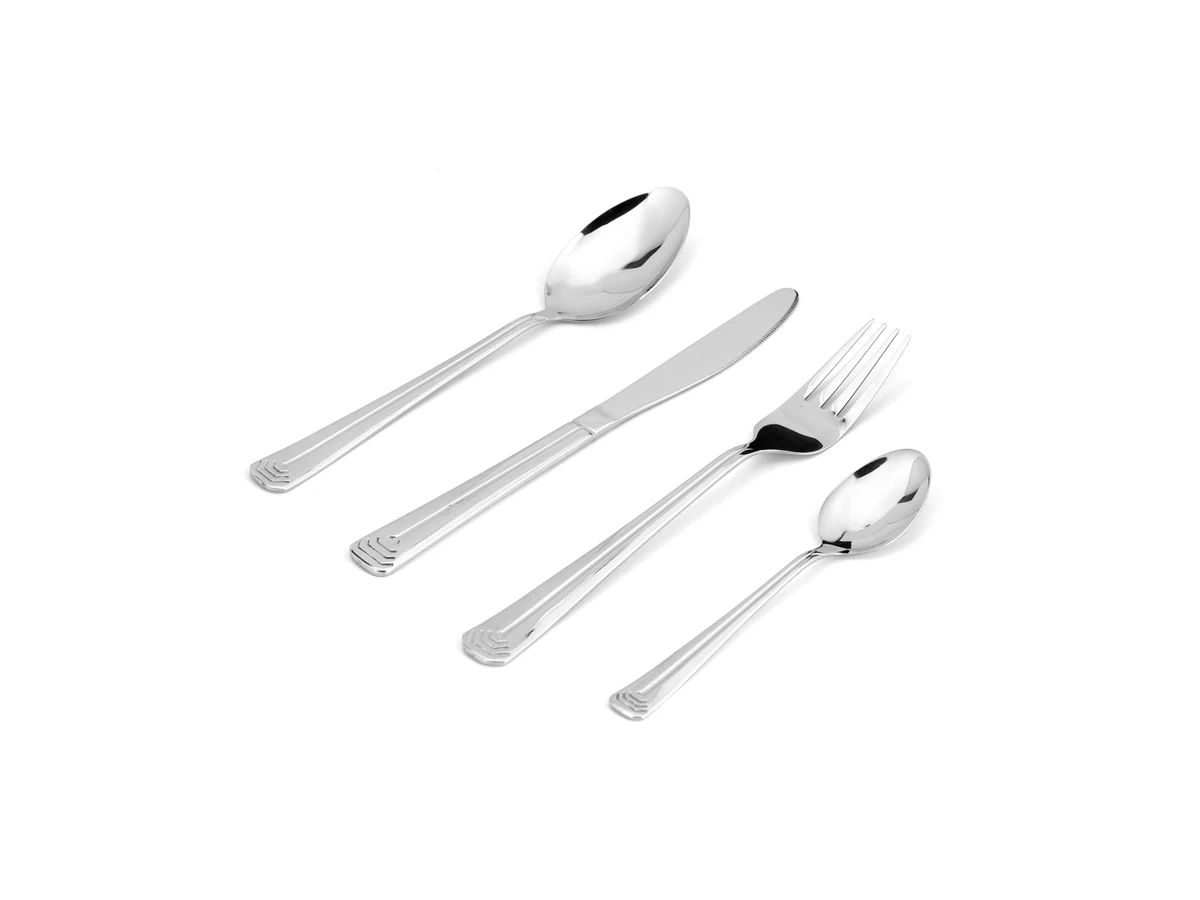
Multi-piece flatware is a merchandising decision before it is a manufacturing one. Buyers who treat a range as "one set, several colours" usually end up with three products competing for the same shelf space. A piece-count ladder fixes that: each rung answers a different shopper, at a different price, in a different box.
This guide is written for importers, distributors and private-label brand owners building a retail range. It covers how many rungs to run, which pieces to duplicate first, how packaging tracks piece count, and how to sample a ladder rather than a single set. The product line behind the examples is our multi-piece flatware sets collection, where each SKU is documented by piece allocation rather than by a fixed commercial pack.
What a Multi-Piece Assortment Actually Decides
Every multi-piece set answers four questions at once: how many people are served, which courses are covered, how the set is presented in retail packaging, and what the shelf price can be. Changing the piece count changes all four. A 16-piece set in a window box and a 24-piece set in a rigid gift carton are not the same product with two extra forks — they are positioned at different occasions and different price points.
That is why piece count should be chosen from the retail channel backwards, not from production convenience forwards. If the target is a mid-market department store, a 20-piece set usually sits in the sweet spot between gift credibility and attainable price. If the target is e-commerce first, a compact starter set often converts better because shipping cube and return rates stay low.
Building the Piece-Count Ladder
A workable retail ladder normally has three rungs. Each rung needs its own piece mix, its own packaging format and its own price band. Running fewer than three leaves gaps; running more than four creates internal cannibalisation.
| Rung | Typical piece count | Shopper | Packaging logic |
|---|---|---|---|
| Entry | 16–20 | First flatware purchase, small household, gifting under a price threshold | Compact carton, one insert tray, minimal copy |
| Core | 20–24 | Established household replacing a worn set | Window box or printed sleeve showing the full piece line-up |
| Premium | 24–45 | Wedding registry, hospitality-grade home use, premium gifting | Rigid box, fabric roll or divided tray, heavier board stock |
The numbers are direction, not rules. What matters is that the three rungs share a design language — the same handle profile or the same pattern family — so the range reads as one brand while the price steps stay visible.
Which Pieces to Duplicate First
When piece count rises, the extra pieces should follow real usage frequency. The order that works for most Western markets is: dinner fork, dinner knife, teaspoon, salad fork, soup spoon, then serving pieces. Duplicating forks before spoons is generally safer than the reverse, because forks are the piece that runs short first in daily use and the piece most often lost.
For a full breakdown of how 16, 20 and 24-piece configurations are assembled, see our flatware set composition guide. The ladder approach differs from that piece-count arithmetic: it asks which rung belongs in which channel, not how to fill a box.
Price Band, Packaging and Cube
Piece count drives cost in three places: metal weight, packaging volume and labour at packing. A 24-piece set does not cost 50% more than a 16-piece set — it costs more in metal, but also jumps a packaging size class, which changes carton cube, pallet yield and freight per unit. Model the landed cost per rung before fixing retail prices; our landed cost walkthrough shows the cost lines to include.
Packaging is also where compliance bites. Retail packaging claims, material labelling and warning text differ by destination market. The U.S. retail packaging checklist lists what to settle before artwork is finalised.
Sampling a Ladder Instead of a Single Set
Sample the rungs together. Approving a 24-piece set in isolation tells you nothing about whether the 16-piece version still looks like a complete product on shelf. Ask for the full ladder in production packaging, photographed side by side under retail lighting, with the piece list printed on each box. Then check three things: that the piece lists are genuinely different, that the packaging sizes step up visibly, and that the handle finish matches across rungs so the range reads as one line.
Record the approved sample reference for each rung. When repeat orders come, the reference sample is the only reliable way to keep a rung identical — the process is described in keeping custom flatware identical across repeat orders.
Handing the Specification to a Manufacturer
A usable brief for a multi-piece range contains: piece list per rung, steel grade and thickness, handle construction, finish, weight target per piece, packaging format and artwork responsibility, target price band, and the destination markets that drive compliance. Vague briefs produce quotes that cannot be compared, because each supplier fills the gaps differently.
Our multi-piece flatware sets are quoted from the piece allocation you specify, with material grade, unit weight, MOQ, production schedule and packaging count confirmed per purchase order. If you are building a three-rung ladder, send the piece list for each rung and we will return the spec gaps that need a decision before sampling.