
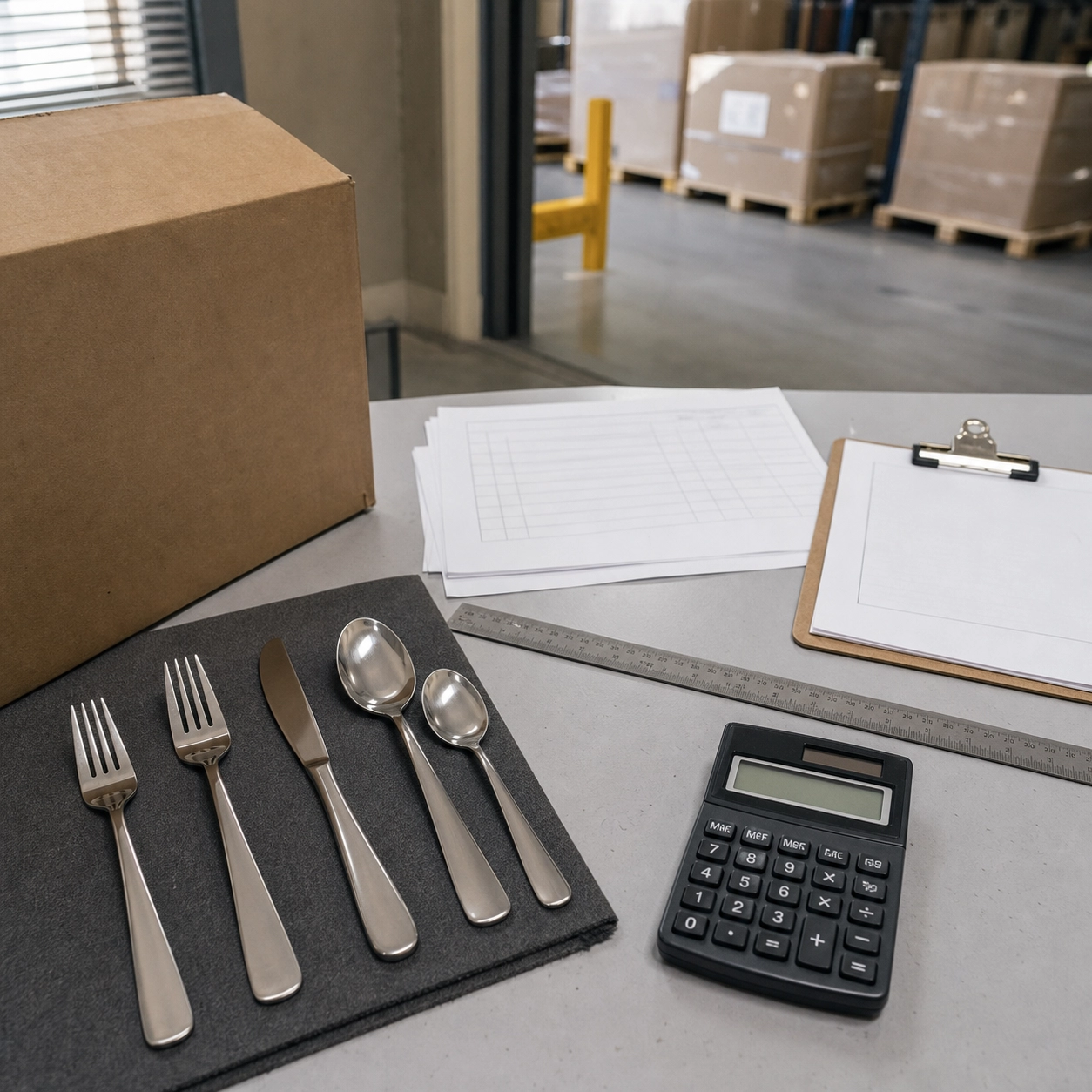
The lowest flatware unit price is not necessarily the lowest-cost purchase. U.S. importers need a landed-cost model that combines the merchandise price with origin charges, freight, customs duties and fees, brokerage, drayage, inspection, domestic delivery, financing, and expected quality loss. This article shows how to build that model without guessing at tariff rates or hiding assumptions inside a single per-set number.
Use a Landed-Cost Formula That Keeps Every Assumption Visible
For purchasing decisions, calculate landed cost to your receiving point, not merely to the port. A useful model is:
Landed cost = merchandise + origin charges + international freight + insurance + customs duty and additional tariffs + import fees + broker and bond + port or terminal charges + drayage + inspection + domestic delivery + financing + expected quality loss
Divide the result by the number of saleable units, not the number ordered. If a set contains 20 pieces but you sell it as one retail unit, calculate both cost per set and cost per individual piece. The piece-level view helps when replacements, assortments, and case packs differ.
Require the Same Data From Every Flatware Supplier
A quote cannot be compared if one supplier priced FOB, another priced EXW, and a third offered an unexplained delivered figure. Issue an RFQ template that forces the same commercial and packaging fields.
| RFQ field | Minimum detail | Cost affected |
|---|---|---|
| Product construction | Steel by piece, dimensions, thickness points, weight, finish, logo, and set composition | Merchandise price, duty classification, and quality risk |
| Price basis | Named Incoterm, named place or port, currency, quotation validity, and included charges | Origin handling, freight, and risk allocation |
| Packaging | Consumer pack, inner pack, case pack, carton dimensions, net weight, gross weight, and pallet plan if used | Cube, weight, labor, damage, and fulfillment cost |
| Production schedule | Sample timing, material approval, artwork cutoff, production lead time, and shipment-ready date | Inventory, financing, and launch risk |
| Order terms | MOQ by SKU, finish and package; payment schedule; tooling ownership; spare quantity | Cash requirement and write-off risk |
| Documents | Commercial invoice fields, packing list, country-of-origin marking plan, and requested test reports | Customs clearance and compliance cost |
Ask for both total carton count and the packing calculation that produces it. A quote stating 100,000 pieces is incomplete if the assortment contains different quantities of knives, forks, spoons, and teaspoons.
Separate Customs Value From Your Internal Landed Cost
Your landed-cost worksheet is an operating model. Customs value is determined under U.S. customs valuation rules. They are related, but they are not the same calculation.
CBP states that the commercial invoice should show the price paid by the U.S. buyer for the goods rather than the U.S. resale value. CBP also notes that certain additions, such as packing, assists, royalties, proceeds, and selling commissions, may need to be included, while international freight and insurance can be excluded when properly identified. Review the current CBP guidance on commercial invoice value with your customs broker for the facts of your transaction.
Flatware generally falls within HTS heading 8215, but the correct subheading can depend on the merchandise, set composition, material, and how the goods are entered. Do not copy a competitor’s HTS code into your purchase order. Search the current Harmonized Tariff Schedule maintained by the U.S. International Trade Commission, review relevant CBP rulings, and obtain broker or binding-ruling guidance when classification is uncertain.
Duty rates and additional trade remedies can change. Your model should therefore store the HTS code, origin, base duty, any additional tariff program, source URL, reviewer, and verification date in separate fields. A hard-coded rate with no date becomes unreliable quickly.
Why Incoterms Change Quote Comparability
An Incoterm allocates specified costs, delivery obligations, and risk between seller and buyer. It does not by itself settle product quality, payment, title, intellectual property, or U.S. importer-of-record responsibility.
| Quote basis | What the U.S. buyer must clarify | Typical comparison risk |
|---|---|---|
| EXW | Pickup, export handling, export clearance responsibility, loading, and origin documentation | A low product price can be offset by unquoted origin costs |
| FOB named port | Exact port, included local charges, booking process, and shipment-ready terms | Suppliers may describe local-charge inclusions differently |
| Delivered or DDP offer | Importer of record, HTS classification, declared value, duties, bond, broker, destination accessorials, and document ownership | A single delivered number can hide compliance assumptions and future adjustments |
State the edition of the Incoterms rules and the named place. Have the buyer’s logistics provider and customs broker review responsibility boundaries before using any delivered quote as the benchmark.
Flatware Packaging Changes Freight, Damage, and Fulfillment Cost
Flatware is dense. Gross weight can become the constraint before a container or truck uses all available cube, while elaborate retail packaging may shift the constraint back toward volume. Model both weight and space.
Collect net and gross weight per carton, outside carton dimensions, case pack, inner pack, pallet dimensions, pallet count, and maximum stack height. Ask whether the quoted carton specification is the actual export carton or a preliminary estimate.
Packaging choices also affect saleable yield. Individual sleeves can reduce metal-to-metal scratching but add material and unpacking labor. A gift box can support retail positioning but may increase cube, corner damage, and replacement cost. A bulk pack may be efficient for hospitality distribution but unsuitable for e-commerce fulfillment.
Add Quality, Financing, and Inventory Risk to the Model
Inspection and testing are planned costs, not exceptions. Add sample freight, third-party material checks when required, pre-shipment inspection, and reinspection contingencies. Use the flatware sample inspection checklist to define what must be approved before the deposit or production release.
Financing cost depends on when cash leaves your account and when saleable inventory is available. Record deposit date, balance date, shipment-ready date, transit assumption, customs clearance, receiving time, and customer payment terms. A longer cycle can erase a small unit-price advantage.
Expected quality loss should be based on your verified history by supplier, SKU, finish, and package. If no history exists, do not invent a defect percentage. Run sensitivity cases and replace the assumption after the first inspections and receipts.
Compare Quotes in Three Layers
- Normalize the product. Confirm that steel, weight, dimensions, finish, logo, set composition, packaging, inspection, and delivery basis match.
- Calculate landed cost per saleable unit. Keep duties, freight, fees, and risk assumptions visible instead of burying them in one manual adjustment.
- Stress-test the decision. Recalculate for freight changes, tariff changes, production delay, lower container utilization, and a reasonable range of quality loss.
A useful supplier comparison includes a confidence column. Mark each cost as firm quote, current published fee, broker estimate, factory estimate, or buyer assumption. The model then shows not only which quote is lower, but which decision carries more uncertainty.
For broader sourcing controls, pair this calculation with our flatware procurement strategy guide for importers.
Common Landed-Cost Errors
- Comparing EXW and FOB unit prices without adding origin handling.
- Using a tariff rate from an old shipment without checking current HTS treatment.
- Assuming a 24-piece set and 24 loose pieces have the same classification or packaging economics.
- Ignoring carton gross weight, cube, and case-pack differences.
- Using ordered quantity rather than saleable received quantity as the denominator.
- Leaving inspection, sample freight, broker, bond, drayage, and destination charges outside the model.
- Treating DDP as a complete compliance answer without identifying the importer of record.
- Failing to date every rate and assumption.
FAQ
Should duty be calculated on FOB or CIF value?
Do not use a shortcut without reviewing the transaction. CBP guidance explains that international freight and insurance are generally not part of the dutiable transaction value when properly identified, while other additions may apply. Ask your customs broker to confirm the declared value and documentation.
Is the supplier’s HTS code enough?
No. Classification is a U.S. import responsibility and must reflect the actual goods as entered. Use the current HTS, relevant CBP rulings, and professional review where needed.
How should tooling be treated?
Track tooling as a separate project cost and review whether it is also an assist or otherwise relevant to customs value. Allocate it by expected production volume for internal profitability, but have the customs treatment reviewed separately.
What is the best Incoterm for flatware?
There is no universal best term. The right choice depends on the buyer’s origin logistics capability, shipment size, control requirements, and import structure. Compare total cost and responsibility, not the three-letter term alone.
Make the Quote Auditable Before You Choose a Supplier
A reliable landed-cost model lets another person trace every number to a quotation, current government source, broker estimate, or dated buyer assumption. That visibility is more valuable than a precise-looking total built from inconsistent inputs.
If you are comparing flatware quotations, send us the item specification, set composition, steel by piece, finish, packaging level, order quantity, requested Incoterm, destination, and target shipment window. We can return a factory quotation with the product and carton fields your U.S. landed-cost worksheet needs; duties, import fees, and classification remain subject to your broker’s current confirmation.