
A practical Thanksgiving table setting starts with the menu. Put forks to the left of the plate, knives to the right with their cutting edges facing inward, and spoons to the right when the meal needs them. Set only the pieces guests will use, then count dessert utensils, serving pieces and clean reserves separately.
For caterers, hotel food-and-beverage teams and flatware distributors, that simple layout becomes a purchasing specification. This guide connects a usable holiday table with an item-by-item order, a finish review and an arrival plan. The quantity examples are planning calculations, not claimed industry averages or a substitute for your venue's service records.
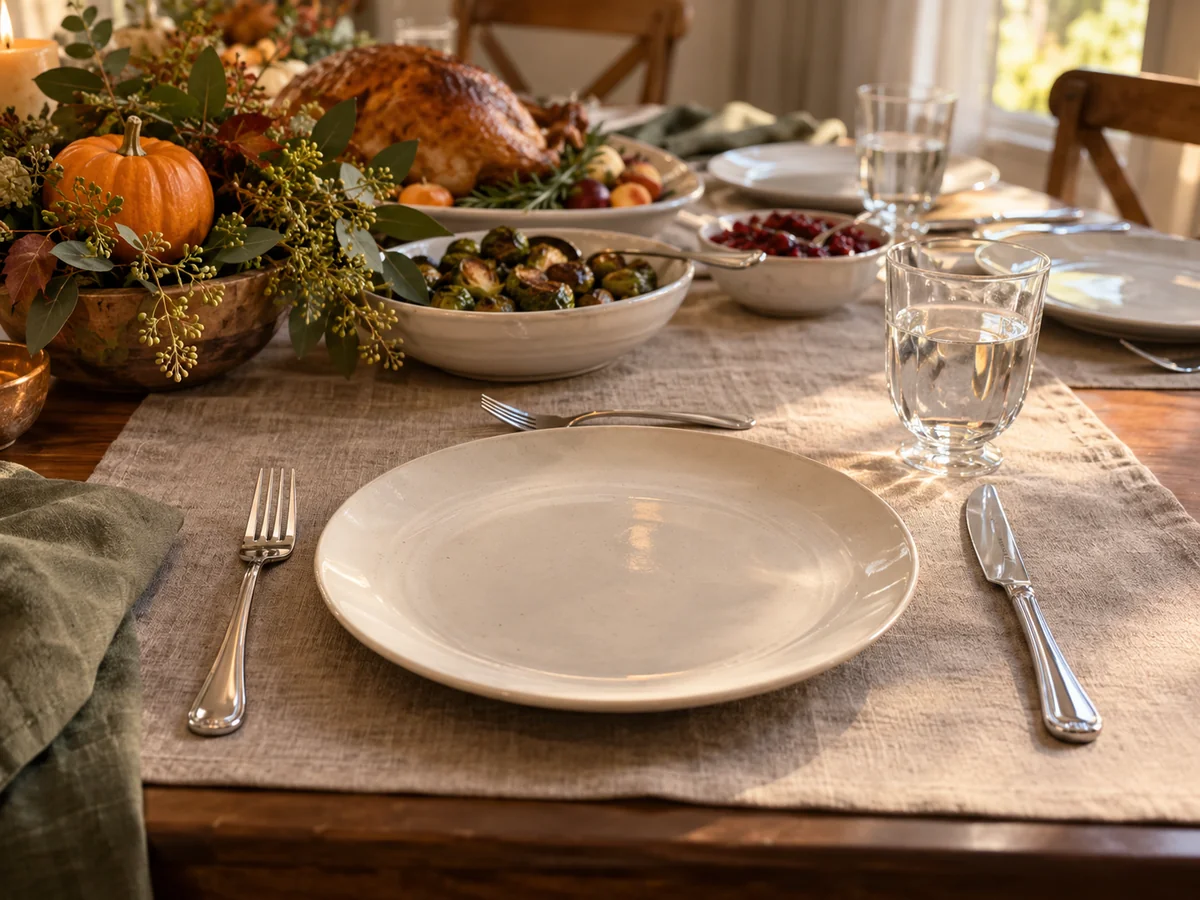
Build a Thanksgiving table setting around the actual menu
Write down what guests will eat and when it will be served before selecting a flatware configuration. Turkey, vegetables and pie do not automatically require a formal multi-course setting. The Emily Post Institute's Thanksgiving table-setting guidance likewise shows several service formats and removes utensils for courses that are not being served.
| Service plan | Pieces to consider | Decision before ordering |
|---|---|---|
| Main course and pie | Dinner fork, dinner knife, separate dessert fork | Will the dessert utensil be preset or delivered with pie? |
| Separate salad course | Add a salad fork if the dinner fork will be cleared | Confirm the clearing sequence with the service team |
| Soup starter | Add a soup spoon suited to the bowl | Check spoon depth and length against the actual bowl |
| Coffee or tea service | Add teaspoons where required | Count beverage stations as well as seated service |
| Buffet meal | Preset flatware or provide it at the end of the line | Choose the location before printing setup instructions |
| Shared platters and sides | Separate serving spoons, forks or tongs | Assign an appropriate serving utensil to each dish |
A dessert fork is a separate requirement even when the main-course fork looks suitable for pie. If staff clear the main course before dessert, that original fork may no longer be available. Conversely, adding a soup spoon to every setting when soup is absent increases handling, washing and storage without improving service.
Leave room for platters, glasses and the guest's hands
Lay out one complete setting with the actual plate, glassware, linen and centerpiece. Start with the dinner fork on the left and the knife on the right. Where several courses are preset, place the utensils in the order they will be used, working from the outside toward the plate; dessert pieces can also arrive with dessert.
Test the setting with a chair occupied and the neighboring place setting in position. A photograph taken from above can hide a crowded table edge, an awkwardly placed glass or a serving platter that blocks access to a fork. Move decorative items before reducing the space guests need to eat comfortably.

For family-style service, pass the largest platter through the trial setting. For buffet service, walk the route while carrying a plate and a drink. These checks reveal whether a rolled flatware bundle, a preset setting or a separate collection point will be easier for guests and staff.
Calculate flatware quantities for 12, 24, 50 or 100 guests
Count each item independently. For a single seating with a main course and pie, suppose every guest receives one dinner fork, one dinner knife and one separate dessert fork. The example below adds a 20% clean reserve to each item and rounds each result upward to a whole piece.
The reserve is an illustrative assumption, not a universal hospitality standard. Increase or reduce it using your handling losses, washing turnaround, break between sittings and replacement history. The calculations exclude staff meals, serving utensils, soup spoons and beverage-service teaspoons.
| Guests | Dinner forks | Dinner knives | Dessert forks | Total pieces |
|---|---|---|---|---|
| 12 | 15 | 15 | 15 | 45 |
| 24 | 29 | 29 | 29 | 87 |
| 50 | 60 | 60 | 60 | 180 |
| 100 | 120 | 120 | 120 | 360 |
For the 100-guest example, each item is calculated as 100 × 1.20 = 120. If the purchase unit is a dozen, 120 pieces equal 10 dozen of that item. A different carton pack may require further rounding; show both the required piece count and the supplier's selling unit on the order.
Do not assume a second seating can use the same inventory. If the first seating's flatware will still be in collection, washing, drying or inspection when the next setting must be ready, it is unavailable stock. Use a service timeline or the site's restaurant flatware par-level guide to account for overlapping demand.
Compare finishes under the lighting guests will see
Silver-tone flatware gives a venue a flexible starting point when the same inventory serves Thanksgiving, Christmas and ordinary restaurant service. Gold-tone or other colored finishes may suit a specific palette, but approve their color with the real linens and glassware. A product thumbnail on a bright screen is an unreliable color reference.
| Option | Useful consideration | What to verify |
|---|---|---|
| Mirror-polished silver-tone | Easy to evaluate across several table palettes | Glare, visible marks and consistency between item types |
| Satin or brushed silver-tone | Creates a quieter visual surface | Brushing direction and matching appearance across reorders |
| Gold-tone finish | Connects warm linens and decorative accents | Exact treatment, physical color sample and care instructions |
| Textured handle | Adds detail without adding another table accessory | Comfort, edge finishing and cleaning access around texture |
Finish color does not identify the underlying steel grade or establish commercial dishwasher suitability. Request those details separately. For purchasing language and approval points, use the flatware finish comparison alongside the physical samples.
Approve a working place setting before releasing an order
Approval should cover a complete dinner fork, knife and dessert piece, not only the most attractive item. Check overall dimensions, balance, spoon-to-bowl fit if relevant, fork tips, knife function and edges that contact the hand or mouth. Record the approved pattern and finish so purchasing, service and inspection use the same reference.
- Arrange one complete sample setting with the actual tableware.
- Run through serving, clearing and dessert delivery.
- Review finish appearance in daylight and the event lighting.
- Confirm material, dimensions, weight and agreed tolerances per item.
- Review washing and drying instructions for the specific finish.
- Count an example inner pack and check its label against the item list.
- Keep an approved reference sample and dated photographs.
A retail set can be convenient for a home host, while a venue may need individual-item replacement packs. Confirm the exact composition before buying either format. The flatware set composition guide explains why a box labeled with a total piece count does not necessarily serve the number of guests a buyer expects.
Work backward from the date the flatware must be ready
For an event order, the useful deadline is the date stock must be inspected and ready for setup. Include receiving, discrepancy resolution and any extra preparation in that deadline. Ask a supplier for separate dates covering sample approval, bulk production completion, dispatch and estimated arrival; transit estimates do not include every receiving task.
A late-October inquiry does not establish that a newly customized overseas order can arrive before Thanksgiving. Existing inventory, a rental allocation or a different approved pattern may be the workable option when the calendar is tight. Verify actual availability rather than inferring stock from a published product page.
For distributors planning future seasonal assortments, the planning window starts well before the dinner itself. Pinterest's July 2026 holiday-planning guidance reports holiday activity beginning to spike as early as September on its platform. That is a merchandising timing signal, not a factory lead-time guarantee or a measurement of this keyword's Google search volume.
Questions buyers ask before holiday service
How many pieces belong in a Thanksgiving place setting?
Use the menu to decide. A dinner fork and knife cover many main courses, while pie or another separate dessert may need its own fork or spoon. Add salad forks, soup spoons and teaspoons only when the courses or beverage service require them. Count serving utensils separately from personal place settings.
Should dessert flatware be placed above the plate?
It can be, but staff can also bring it with dessert. Presetting makes the utensil available immediately; later delivery keeps the main setting simpler. Choose one method and include it in the setup instructions so staff do not accidentally omit dessert flatware or supply it twice.
How much extra flatware should a caterer order?
There is no single allowance that fits every service. Start with the pieces needed before washing returns clean inventory, then add a reserve based on your operations. The 20% allowance in this guide demonstrates the arithmetic. It is not a measured loss rate or a required order quantity.
Can colored flatware go through a commercial dishwasher?
Confirm the specific product's written care conditions with the supplier. Ask about the surface treatment, detergent compatibility and the planned wash process. Do not extend a general stainless-steel care statement to every colored finish. Review the flatware cleaning guide when preparing operating instructions.
What should a holiday flatware RFQ include?
List guests, service format, exact pieces and quantities, finish reference, packaging and the required ready-for-service date. Include the delivery destination and any replacement requirements. Request confirmation of actual material options, MOQ and bulk production timing for that specification rather than using another supplier's catalog figures.
Turn the table plan into an itemized buying brief
A successful Thanksgiving table setting gives guests the utensils they need and gives staff enough clean stock to maintain service. Freeze the menu, test one complete setting and order by item. Use decorative preferences to choose among approved specifications, then verify the delivery plan before committing to an event date.
Jieyang Hongsheng Hardware Products Co., Ltd. supplies stainless steel flatware for B2B programs. To discuss an assortment, send your piece list, estimated quantity, finish reference, packaging format and required arrival date through the project inquiry page. Material options, MOQ and bulk lead time can then be checked for the actual order.