
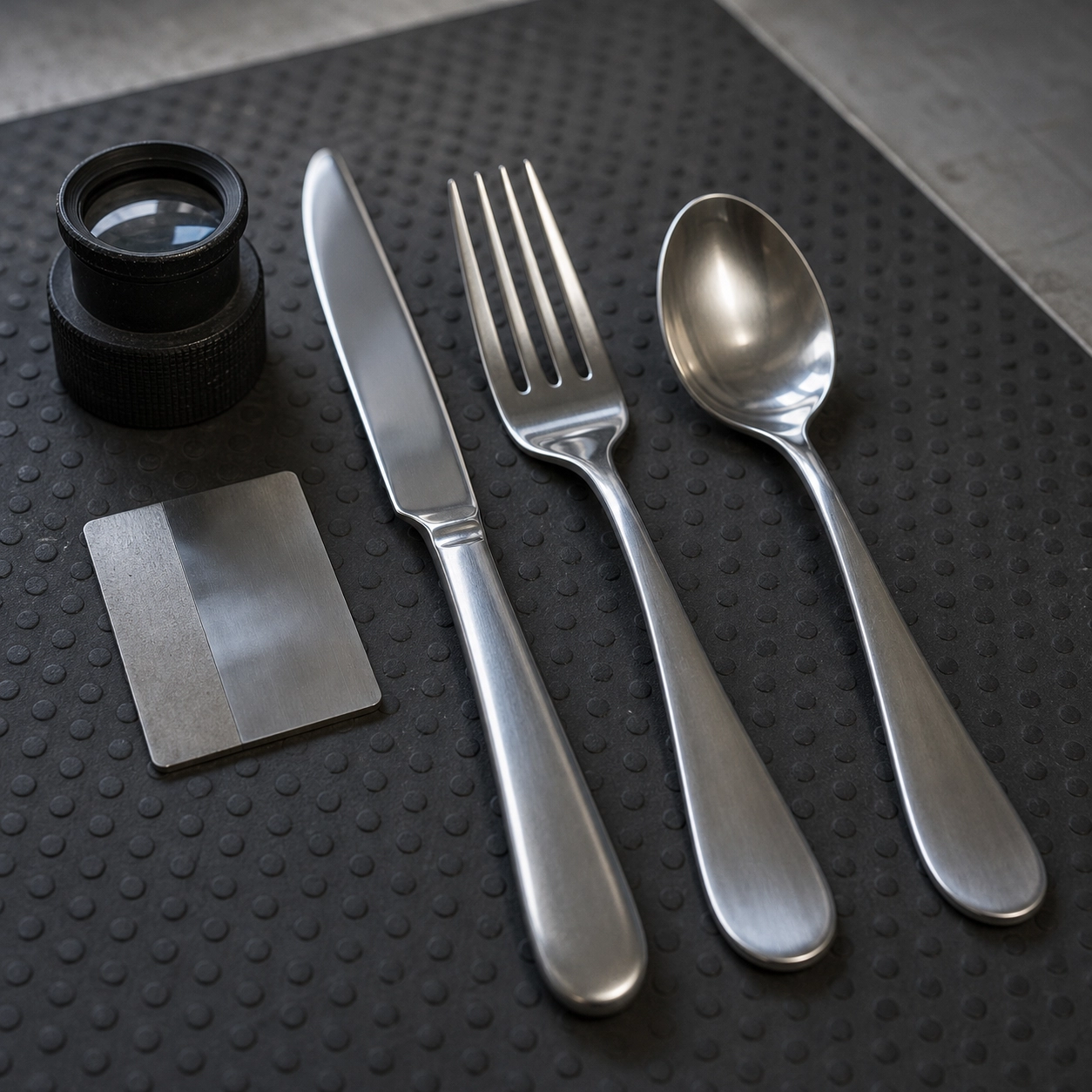
A flatware set can legitimately use more than one stainless steel. Forks and spoons need formability, corrosion resistance, and a surface that polishes and cleans well. A table knife also needs hardness and edge retention, so its blade is often made from a hardenable martensitic stainless steel rather than the 18/10 or 18/0 material used for the other pieces. U.S. buyers should therefore specify and verify material by component, not only by set.
A Fork, Spoon, and Knife Do Not Need the Same Properties
A spoon begins as sheet or coil and must form into a bowl without cracking or excessive springback. A fork must be blanked, formed, and finished so the tines are aligned and the edges are smooth. Both pieces benefit from corrosion resistance and a stable polished surface.
A knife must cut. Even a rounded table knife needs an edge or serration that survives repeated contact with plates and food. That requirement shifts material selection toward grades that can be heat treated for hardness.
Using one alloy for every piece can force a compromise. A highly formable spoon material may not deliver the desired knife edge, while a hardenable knife grade may be unnecessarily difficult to deep-form into a spoon bowl.
Three Stainless Steel Families Commonly Appear in Flatware Discussions
| Stainless family | Common trade example | Useful property | Typical flatware role |
|---|---|---|---|
| Austenitic | Type 304; often associated with 18/8 or 18/10 descriptions | Good formability and corrosion resistance for many food-contact uses | Forks, spoons, serving pieces, and some handles |
| Ferritic | Type 430; often associated with 18/0 descriptions | Nickel-free alloy route, magnetic response, and different cost-performance balance | Forks, spoons, and value-positioned flatware |
| Martensitic | Type 420 and related cutlery grades; sometimes described as 13/0 | Can be hardened by heat treatment for cutting and wear resistance | Knife blades and cutting utensils |
This table is a selection framework, not a substitute for the exact grade designation and purchase specification. Alloy chemistry, product condition, heat treatment, thickness, forming, grinding, polishing, and passivation all affect the finished performance.
The Nickel Institute explains the familiar 18/10, 18/8, and 18/0 marks used on forks and spoons. Outokumpu’s Type 304 information identifies 304 as an 18% chromium, 8% nickel austenitic grade with broad corrosion resistance.
Why Knife Steel Must Harden
Martensitic stainless steels can be heat treated to obtain the hardness needed for a cutting edge. World Stainless notes that Type 420 is frequently used for table knives and describes higher-performance knife constructions using other martensitic grades. See its technical publication on martensitic stainless steels.
Material name alone does not define knife performance. The buyer may need to specify the blade construction, hardness range, edge geometry, serration pattern, grinding finish, and corrosion test. Heat treatment that improves hardness can also affect corrosion behavior and toughness, so the target must be developed around the actual table-knife application rather than copied from a kitchen knife.
Outokumpu’s Type 420 data lists cutting utensils among typical applications. The factory or steel supplier should still confirm the exact grade, condition, and heat treatment used for the quoted knife.
What 18/10, 18/8, 18/0, and 13/0 Do Not Tell You
These marks are useful shorthand, but they do not answer every procurement question. They do not automatically identify a complete ASTM or UNS designation, dimensional tolerance, hardness, recycled content, surface treatment, corrosion test, country of origin, or whether every piece in the set uses the same steel.
For example, a package marketed as 18/10 flatware may reasonably refer to its forks and spoons while the knife uses a martensitic blade steel. The problem is not the mixed construction; the problem is an ambiguous specification or claim that leaves the buyer unable to verify what each component contains.
Ask the supplier to provide a component material schedule:
- Dinner knife blade and handle, including whether the knife is one-piece, hollow-handle, or assembled.
- Dinner fork, salad or dessert fork, and specialty forks.
- Tablespoon, soup spoon, teaspoon, and serving pieces.
- Decorative inserts, coatings, adhesives, or nonmetal handle materials.
How to Write a Flatware Material Specification
Write requirements by piece and by measurable result. The following fields reduce disputes:
| Specification field | Buyer decision | Evidence or approval |
|---|---|---|
| Alloy by component | Recognized grade or agreed chemistry range for each piece | Material declaration, mill document, and agreed verification plan |
| Knife performance | Construction, hardness target, edge or serration, and cutting acceptance | Approved production sample and defined test method |
| Corrosion and surface | Finish, passivation requirement, exposure test, and acceptance criteria | Lot test or third-party report when required |
| Dimensions and mass | Length, thickness at named points, weight, and tolerance | Drawing, inspection record, and retained sample |
| Claims and marking | Permitted grade wording, care language, and country-of-origin plan | Approved artwork and claim-support file |
If the intended use is commercial foodservice, review smoothness, durability, and warewashing expectations as part of product design. The FDA Food Code 2022 calls for multiuse utensils to be safe, durable, corrosion-resistant, sufficiently substantial for repeated warewashing, and finished with smooth, easily cleanable surfaces.
Verify the Production Material With More Than One Control
- Approve a component schedule. List the steel for each piece and assembled component before quotation approval.
- Review supplier documents. Confirm heat or coil traceability required by the buyer and how factory records connect raw material to the production lot.
- Use appropriate alloy screening. XRF can identify many alloying elements, but it may not measure carbon adequately or prove heat treatment and hardness.
- Test knife properties separately. Use a suitable hardness method and a defined cutting or edge check where performance matters.
- Inspect surface condition. Specify passivation or free-iron verification when required. ASTM A967/A967M covers chemical passivation treatments and qualitative tests, but the buyer must identify the applicable edition, method, lot, and acceptance criteria.
- Retain approved samples and reports. Link them to the purchase-order revision and pre-shipment inspection plan.
For a step-by-step physical review, use our stainless steel flatware sample inspection checklist. The existing 304, 430, and 201 comparison provides broader context for fork and spoon material selection.
Common Material-Selection Mistakes
- Specifying 18/10 for the set without defining the knife material.
- Using a magnet as final proof of alloy grade.
- Requesting a hardness value without naming the test method and measurement location.
- Assuming all Type 420 knives perform the same without controlling heat treatment and edge geometry.
- Using food grade as a complete material specification.
- Approving a polished sample before reviewing the material document and production control plan.
- Requiring one steel for every piece when the functions demand different properties.
FAQ
Does an 18/10 flatware set usually have an 18/10 knife?
Not necessarily. Forks and spoons may use an 18/10-associated austenitic grade while the knife uses a hardenable martensitic blade steel. Require a material schedule by piece.
Is 18/0 unsuitable for foodservice?
No. Ferritic stainless steel can be used successfully in flatware when the grade, design, finish, care, and operating environment are appropriate. Buyers should compare corrosion expectations, budget, replacement model, and verified performance rather than rejecting a material from shorthand alone.
Can XRF confirm 18/10 versus 18/0?
XRF can screen chromium, nickel, and other alloying elements and may distinguish these broad material groups. It does not by itself verify all relevant elements, heat treatment, hardness, surface condition, or finished-product performance.
Why can a knife show rust spots before a spoon?
The pieces may use different stainless families, surface conditions, heat treatments, and grinding processes. Embedded iron, chloride exposure, prolonged moisture, detergent chemistry, and incomplete drying can also contribute. Investigate the batch and process rather than assuming one cause.
Specify the Set Component by Component
The right question is not which single stainless steel is best for flatware. The right question is which material and process meet the function of each piece, the buyer’s care environment, and the required price-performance position.
If you are comparing materials for a new set, send us the required pieces, intended market, target weight, finish, dishwasher or commercial-use expectations, knife edge requirement, and estimated order quantity. We can propose a component-level specification for review; exact grade availability, hardness, tests, certifications, MOQ, and lead time require factory confirmation before sampling.