
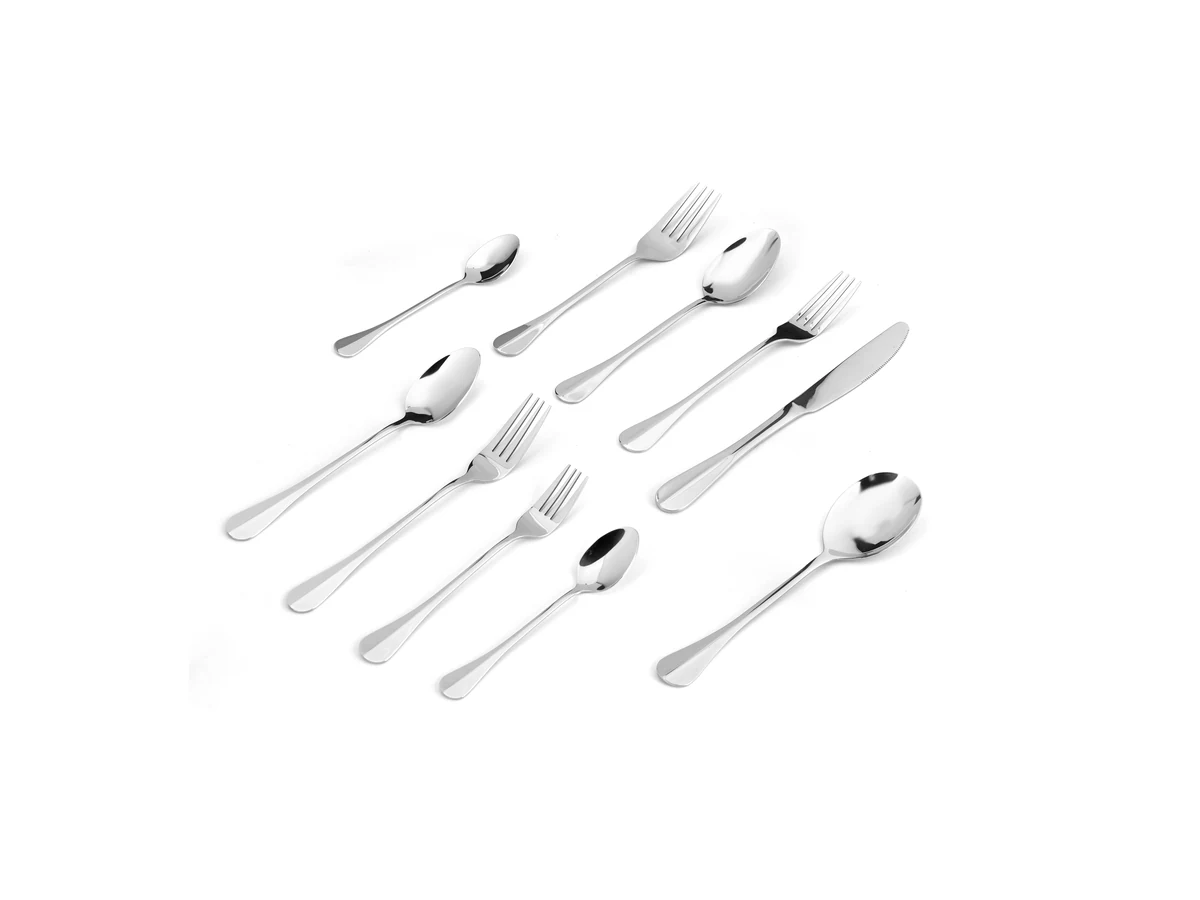
Send an enquiry for a stainless steel flatware programme to five factories and you will get five quotations that look directly comparable and are not. One quotes 18/10 at a lighter gauge, another quotes 18/0 at the correct weight, a third folds tooling into the unit price, and a fourth has quietly removed the gift box. Comparing the headline number across those four documents tells you almost nothing.
This guide breaks a flatware quotation into its parts, shows which variables actually move the price, and gives a normalisation method that turns four incomparable offers into one decision.
In this article
Anatomy of a flatware quotation
A usable quotation is a specification with a price attached. If any block below is missing, the price is not yet comparable to anything.
| Block | What must be stated |
|---|---|
| Product specification | Item list, steel grade per item, thickness or gauge, weight per piece in grams, finish, handle construction, edge and polish standard |
| Pricing structure | Unit price per item, price per set or box, price per carton, currency, price validity period, MOQ tiers |
| One-off costs | Tooling and pattern development, sample charges and whether they are credited against the first order, artwork and printing plates for packaging |
| Packaging | Polybag or gift box, insert or tray, retail-ready or bulk, carton quantity, carton dimensions and gross weight |
| Delivery | Incoterm and named place, port of loading, production lead time from deposit and sample approval, shipping method assumed |
| Payment | Deposit and balance split, acceptable instruments, whether payment terms change at higher volumes |
| Compliance and inspection | Which test reports are included and at whose cost, inspection standard and AQL, who pays for third-party inspection, claims window and remedy |
The five variables that actually drive price
- Steel grade. 18/10, 18/0 and lower-nickel grades differ in material cost and in how they perform in service. Grade also determines nickel content, which matters for both corrosion resistance and regulatory testing.
- Thickness and weight. Within the same pattern, a heavier fork costs more steel and more forming effort. Weight per piece in grams is the most useful single number for comparing like with like, and it is frequently omitted from the cheapest quotes.
- Finish and polishing. Mirror, satin, hammered, two-tone and coated finishes sit at different points on the labour curve. Mirror polishing on a complex handle is the most expensive conventional finish; a uniform satin finish is the least.
- Handle construction. Solid, hollow and weighted handles are different manufacturing routes with different cycle times, and the difference is visible in both price and balance in the hand.
- Volume and packaging. Tooling amortisation per unit falls with order size, and retail-ready packaging can cost more than the flatware it contains on low-value sets. Ask for the packaging cost as a separate line so you can decide.
What an incomplete quote hides
A lower price usually comes from somewhere specific. These are the substitutions that explain most of the gap between the highest and lowest quote for the same brief.
- Grade not stated, or stated only for the knife. If the quote says "stainless steel" without a grade, the number is not auditable and the delivered goods may be whatever was available.
- Weight described as approximate. Weights vary within a pattern, so a tolerance is normal, but "about 60 g" without a limit lets a factory land at the bottom of the range.
- Thickness omitted while weight is given. The two are related but not identical across patterns; ask for both.
- Packing simplified without saying so. Bulk bag instead of a gift box, no insert, thinner cartons. Freight damage claims usually trace back to this line.
- Tooling excluded, then charged later. A per-unit price with no tooling line is not the delivered cost.
- Testing excluded. Market-entry test reports are a real cost. A quote that does not mention them is not cheaper, it is incomplete.
- Price validity of days rather than weeks. Steel prices move; a short validity is not dishonest, but it does mean the number you are comparing may be older than the one next to it.
How to normalise competing quotes
Normalisation takes twenty minutes and prevents a year of arguing. Build a single comparison table with one supplier per column and these rows:
- Specification rows first — grade, weight per piece, thickness, finish, handle construction. If two suppliers differ here, stop and reconcile before looking at price at all.
- Cost per place setting, derived from the item prices. This is the number a retail buyer actually cares about.
- One-off costs, including tooling, sampling and packaging artwork, itemised.
- Amortised one-off cost per unit at your realistic first-order quantity, not at the quantity you hope to reach.
- Cost per container at the declared carton dimensions and quantities, which is where a lighter-gauge, more tightly packed product can look better on paper than it will in the shop.
- Terms: Incoterm, lead time, payment split, validity.
Once the same specification sits across all columns, the price ranking usually changes. If it does not change, you have a genuine cost difference and can negotiate on it knowingly — usually by relaxing something you have decided is not worth paying for, such as the finish level on serving pieces or the retail box on a foodservice line.
Commercial terms that change the real cost
| Term | Why it matters to a flatware buyer |
|---|---|
| Incoterm and named place | EXW, FOB and CIF quotes are not comparable. Pin the port and the exact place of delivery. |
| Lead time anchor | "45 days" means nothing without a start point. Insist on: from receipt of deposit and approval of samples. |
| MOQ per item | Tooling is per pattern or per item, so the MOQ may apply to serving pieces individually. Check before you commit to a 12-item box. |
| Tooling ownership | If you pay for tooling, get written confirmation of ownership and that it is dedicated to your pattern. |
| Claims and remedy | State the notification window for shortages and defects, and what the supplier will do — credit, replacement or repair. |
Red flags worth walking away from
- A price materially below every other quote for an identical specification, with no explanation of how.
- Refusal to quote weight per piece or thickness in writing.
- A quotation with no reference to samples, inspection or compliance documentation.
- Tooling fees that are non-refundable and carry no statement of who owns the tooling.
- An Incoterm written as "FOB" without a named port, or "DDP" without a named destination and duty assumption.
- Price validity shorter than your own approval process.
Frequently asked questions
Why do two quotes for the same set differ by 30 per cent?
Almost always because they are not the same set. Differences in steel grade, thickness, finish labour, packaging and whether tooling is included account for most of the spread. Normalise the specification before treating the gap as a negotiation opportunity.
Should tooling be amortised into the unit price?
Either approach can work, but the tooling cost should always be visible as its own line. Amortised tooling hides the break-even point and makes it hard to know what you paid for if you move the programme later. Itemise it, then decide how to settle it commercially.
How long should a quotation stay valid?
Long enough to cover your own approval cycle, typically 30 days for stainless steel flatware. A validity of a few days is a sign that the quote is indexed to a raw material position the supplier does not want to hold.
Is a lower price ever just a lower price?
Sometimes. A factory with spare capacity, an existing pattern you have been offered rather than a new one, or a larger volume tier can all produce a genuinely lower price at identical specification. That is exactly why the specification has to be fixed first — it is the only way to tell a real cost advantage from a hidden substitution.
A flatware quotation is a specification document first and a price document second. Fix the specification, itemise the one-off costs, normalise to cost per setting and per container, and the commercial decision becomes straightforward rather than a guess about which supplier is telling the truth.