

Short answer: hospitality buyers should specify flatware by service environment, piece list, steel grade, dimensions, weight, finish, care conditions, packaging and replenishment needs. A catalog photo is not enough to control consistency across a commercial order.
This guide is for hotel purchasing teams, restaurant groups, food-service distributors and designers preparing a commercial flatware request for quotation. It uses an application scenario rather than claiming a completed customer case.

Match the Flatware to the Service Environment
The same pattern may perform differently in a breakfast room, banquet hall and fine-dining restaurant. Start with the operating conditions before choosing a design.
| Application | Primary purchasing concern | Useful specification question |
|---|---|---|
| High-turnover restaurant | Wash frequency, replacement cost and easy handling | Can the finish and edge quality remain acceptable under the actual detergent and wash process? |
| Hotel banquet service | Large matching quantities and fast table reset | Can the supplier maintain the same pattern, finish and weight across repeat orders? |
| Fine dining | Balance, visual proportion and course-specific pieces | Are samples available for the chef, operations team and designer to review together? |
| In-room dining | Compact set composition and controlled packing | Can each setting be packed or kitted for the service workflow? |
| Outdoor or poolside service | Humidity, handling and loss rate | Which material and finish should be validated under the property’s actual conditions? |
Build a Commercial Flatware Specification
Use one controlled specification sheet for quoting, sampling, production and inspection. The document should identify the selected pattern by item code or approved image and include the following fields.
| Specification field | What to record | Why it matters |
|---|---|---|
| Piece list | Dinner knife, dinner fork, salad or dessert fork, dinner spoon, teaspoon and any serving pieces | Prevents assumptions about what “five-piece set” or “service for six” includes |
| Material | Declared stainless steel grade for each piece; knife material may differ from forks and spoons | Connects the quote to the required corrosion resistance and price level |
| Dimensions | Overall length, maximum width and relevant thickness | Controls table proportion, rack fit and consistency |
| Weight | Target weight per piece with an agreed tolerance | Affects handling, perceived value and freight planning |
| Finish | Mirror, satin, textured or color-finished area with an approved visual reference | Finish names alone do not define gloss, texture or color |
| Workmanship | Smooth edges, fork-tine alignment, spoon-bowl symmetry, knife-serration condition and acceptable surface marks | Creates objective inspection points |
| Branding | Logo file, method, size, position and orientation | Avoids inconsistent placement between pieces |
| Packaging | Piece protection, inner quantity, master-carton count, labels and carton marks | Reduces transit damage and receiving errors |
Choose Steel by Operating Conditions, Not by Label Alone
18/0, 18/8 and 18/10 are composition descriptions commonly used in flatware sourcing. They are useful starting points, but buyers should also request the supplier’s declared grade and confirm it on the purchase specification. A knife blade may use a different stainless steel from a spoon or fork because cutting performance and hardness requirements differ.
| Common sourcing description | Typical purchasing position | What the buyer should confirm |
|---|---|---|
| 18/0 | Cost-sensitive commercial programs and designs where magnetic storage systems may be relevant | Declared grade, corrosion expectations, finish and validation under the actual wash process |
| 18/8 or 18/10 | Programs prioritizing higher nickel content and corrosion performance | Declared grade, item-specific material, finish, weight and supporting material documentation |
| Color-finished stainless steel | Design-led hospitality concepts | Base steel, coating system, color standard, care instructions and agreed durability test |
| Decorative or mixed-material handle | Restaurants and hotels seeking a distinctive table identity | Handle material, joint construction, cleaning limits and replacement availability |
Do not publish a “dishwasher safe” statement based only on the steel grade. Detergent chemistry, water quality, temperature, drying and any coating or handle component can change the result.
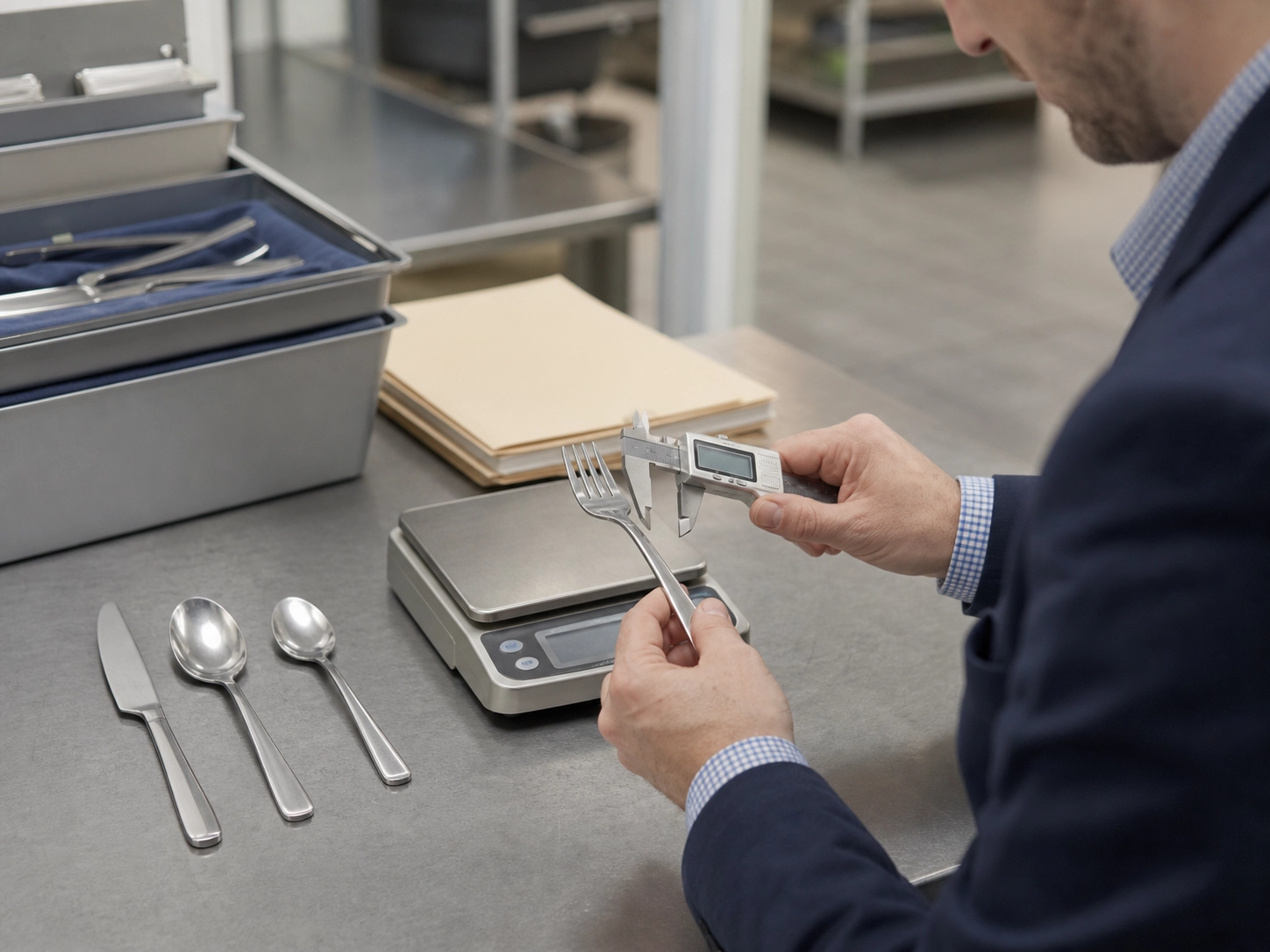
Test the Sample in the Property’s Actual Workflow
- Measure the sample. Record length, width, thickness and weight for each piece.
- Check handling. Ask service staff to assess balance, edge comfort, fork tines, spoon shape and knife performance.
- Run a wash trial. Use the property’s detergent, rinse aid, water and drying process for a buyer-defined number of cycles.
- Inspect in strong light. Look for staining, rust points, coating changes, sharp edges, scratches and trapped residue.
- Approve a reference sample. Sign or seal the accepted version and attach the final specification before production.
If a food-contact test report or other compliance document is required for the destination market, state the exact document and test scope in the request for quotation. Do not assume that one report covers every steel grade, color or handle construction.
Illustrative Application Scenario: Sizing an Opening Order
This is a planning example, not a customer result. A 150-seat hotel restaurant selects a four-piece place setting and plans a par level of three. “Three par” means one set in service, one moving through washing or reset, and one reserve set. The property should adjust the factor to its own operating model.
| Calculation | Example |
|---|---|
| Base quantity per utensil | 150 seats × 3 par = 450 pieces |
| Opening reserve | 450 × 5% = 22.5, rounded to 23 pieces |
| Opening quantity per utensil | 473 pieces |
| Four-piece total | 473 × 4 = 1,892 pieces |
Before placing the order, the buyer should also account for banquet inventory, room service, breakage history, seasonal capacity and the supplier’s standard inner-pack quantity. Rounding to full cartons can simplify receiving and replenishment.
Packaging, Receiving and Replenishment
Commercial flatware does not always need retail packaging. Bulk sleeves, dozen packs or controlled inner boxes can reduce unpacking labor and packaging waste. Polished or color-finished pieces need separators that prevent metal-to-metal rubbing in transit.
Record carton count, net and gross weight, dimensions, carton marks and the number of each utensil per carton. Keep the item code and approved specification in the purchasing system so replacement orders do not rely on a photo or informal description.
Common Purchasing Mistakes
- Choosing only by appearance without testing the real dishwashing process
- Writing “304 cutlery set” without specifying the material for each utensil
- Using “heavy weight” without a target weight or tolerance
- Approving one piece but not checking the full place setting together
- Ignoring carton quantities when calculating par levels and replacement stock
- Assuming the supplier can reproduce a discontinued pattern indefinitely
FAQ
Is 18/10 always the right choice for a hotel?
No. It may suit properties prioritizing corrosion performance, but the correct choice depends on budget, washing conditions, design, replacement plan and required documentation. Evaluate the complete specification rather than one material label.
How should a restaurant compare two flatware samples?
Use a scorecard covering dimensions, weight, balance, edge comfort, polish, fork-tine alignment, knife performance, wash-trial results, price, packaging and repeat-order availability.
Should hospitality buyers order sets or individual pieces?
Individual-piece purchasing is often easier for commercial replenishment. Retail or in-room dining programs may benefit from preconfigured sets. The quote should show both the piece-level quantity and the complete set composition.
What should be sent to a manufacturer for an accurate quote?
Send the piece list, required grade, reference dimensions or samples, finish, quantity, logo, packaging, test requirements, destination port and desired mass-production window.
Prepare the Next Sourcing Step
Review more hospitality tableware guidance or compare a modern teardrop flatware pattern. For a specification-based quotation, provide the seat count, service type, piece list, material target, finish, par level, packaging and destination.