
A private label flatware range is not simply your logo applied to an existing set. It is a set of interlocking decisions — assortment, handle geometry, finish, marking, packaging and reorder economics — and the range succeeds or fails on how coherently those decisions reinforce each other. This guide covers the sequence that produces a branded cutlery range a retail buyer can reorder with confidence.
In this article
Start with the assortment, not the artwork
The most common private label mistake is commissioning packaging artwork before the assortment is fixed. Assortment drives everything downstream: the number of tools, the carton configuration, the retail price point and the shelf presence.
| Range type | Typical configuration | Best suited to |
|---|---|---|
| Essential entry range | Dinner fork, dinner knife, spoon, teaspoon | Volume retail, supermarket own-brand, promotional programmes |
| Extended household range | Above plus salad fork, soup spoon, serving spoon | Mid-market retail and e-commerce sets |
| Hospitality range | Heavier gauge, simplified patterns, often open stock | Hotels, restaurants, catering distributors |
| Gift and premium range | Full place setting, presentation box, sometimes a cutlery chest | Department store, gifting, wedding market |
Decide the range architecture first, then let the remaining decisions serve it. A premium gift range and a volume supermarket range rarely share the same handle thickness, finish or packaging — trying to serve both with one specification produces a product that satisfies neither.
Choosing a handle and finish identity
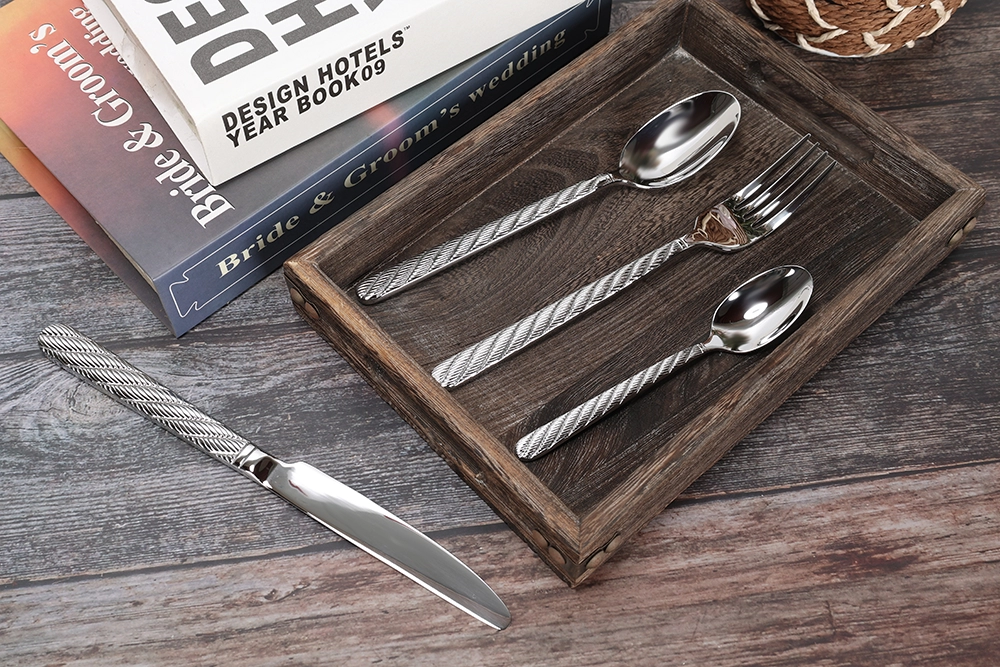
Your handle pattern is the most durable piece of brand equity in a flatware range — more recognisable than the logo, which on most pieces is small and discreet. Three levers define the identity:
| Lever | Options | Brand implication |
|---|---|---|
| Handle geometry | Slim and tapered, broad and rounded, sculpted, openwork | Slim reads contemporary; broad reads traditional and generous |
| Surface treatment | Plain, beaded, fluted, embossed, hammered, textured | Ornament signals heritage; plain signals modern minimalism |
| Finish | Mirror polish, satin or brushed, hammered, two-tone, coloured | Mirror reads formal; satin reads casual and hides wear |
If the range will sit alongside existing tableware in your catalogue, choose the finish to harmonise rather than compete. A high-mirror finish photographed against matte ceramics looks deliberate; the same finish against a mixed metal assortment looks accidental.
Finish and wear: satin and brushed finishes are more forgiving of the fine surface scratches that accumulate in domestic dishwashers. If your target market uses dishwashers heavily, a satin finish often reduces return rates compared with high mirror polish.
Logo execution: emboss, etch or laser
Marking method affects perceived quality, tooling requirements and permanence. The main options:
| Method | Appearance | Durability | Tooling impact |
|---|---|---|---|
| Emboss / stamping | Raised or recessed mark pressed into the metal | Very durable, part of the metal itself | Requires a marking die; best decided before tooling |
| Etching | Chemically recessed, crisp fine detail | Durable; definition depends on depth control | Requires artwork and etching plates; suits fine logos |
| Laser marking | High-contrast surface mark, very fine detail | Good for moderate use; contrast can dull with polishing | No die required; flexible for small volumes |
| Pad printing / colour | Printed colour logo | Less durable; typically decorative only | Minimal tooling; not suited to areas in heavy contact |
Placement matters as much as method. Common positions are the handle face near the neck, the handle end, or the underside of the handle. A mark placed where the thumb rests will wear faster and feel intrusive; a mark on the underside is protected but less visible in product photography.
For retail programmes, confirm the marking method is compatible with the finish. A laser mark on a mirror-polished surface produces a different visual result than the same mark on satin, and the contrast you approved on one sample may not reproduce uniformly across a full pattern.
Packaging as part of the product
In private label, packaging carries as much brand weight as the cutlery itself. The decisions that most often cause delay or rework:
| Packaging element | Decision to lock down | Common pitfall |
|---|---|---|
| Primary unit | Poly bag, sleeve, blister, cardboard backing, gift box | Sleeve dimensions not aligned to handle length |
| Set configuration | Tied set, caddy, tray insert, fabric roll | Insert tolerances too tight for normal piece variance |
| Artwork | Bilingual copy, barcode, country of origin, care instructions | Retailer-specific compliance text omitted until late |
| Protective layer | Anti-tarnish paper, foam, tissue wrap | Omitted, leading to tarnish or scratching in transit |
| Master carton | Piece count, gross weight, carton dimensions, shipping marks | Carton dimension change invalidating the loading plan |
Two operational points save significant time. First, obtain the retailer's packaging specification sheet before commissioning artwork — barcode format, required language, recycling symbols and country-of-origin statements vary by market and are frequently discovered late. Second, approve a physical packed unit, not just a digital proof. Colours shift between screen and print, and structural fit cannot be assessed from a flat file.
Designing for reorder
The economics of private label depend on the second and third order, not the first. Tooling and development costs are amortised over repeat volume, and a range that cannot be reordered profitably is a range that will be discontinued. Protect reorder potential deliberately:
- Fix the specification in a controlled document. Everyone who touches the range — buyer, factory, packaging supplier — works from one version-controlled specification.
- Keep tooling alive. Contract for tooling retention and maintenance terms covering the expected product life.
- Retain sealed samples. Hold a sealed production sample for each SKU and require the factory to do the same.
- Avoid single-source materials. If a handle colour or coating comes from one supplier, confirm the factory has an approved equivalent.
- Design packaging for reasonable volume steps. A carton that only makes sense at one exact quantity forces inefficient reorders.
Commercial terms that protect the brand
| Term | What to secure | Why |
|---|---|---|
| Exclusivity | Pattern, tooling and artwork reserved to your brand for an agreed period or territory | Prevents your design appearing under a competitor label |
| Tooling ownership | Written confirmation of who owns and controls the tooling | Determines your leverage for repeat orders |
| Marking control | Factory may not apply your logo to third-party goods | Protects brand integrity |
| Change notification | Advance notice of any material, finish or process change | Prevents silent substitution in repeat runs |
| Quality baseline | Sealed sample and defined acceptance criteria as the production standard | Provides an objective basis for dispute resolution |
| MOQ and step pricing | Volume tiers agreed in advance | Enables retail pricing planning |
Private label readiness checklist
| Status | Item |
|---|---|
| ☐ | Assortment architecture defined (items per set, range tier) |
| ☐ | Handle geometry and finish chosen and documented |
| ☐ | Logo artwork supplied in vector format with placement specified |
| ☐ | Marking method agreed and validated on a sample |
| ☐ | Retailer packaging specification obtained |
| ☐ | Packed unit sample physically approved |
| ☐ | Sealed production sample retained by both parties |
| ☐ | Specification document version-controlled |
| ☐ | Tooling ownership and retention terms confirmed in writing |
| ☐ | Exclusivity and marking-control clauses in the agreement |
| ☐ | MOQ and volume pricing tiers agreed |
| ☐ | Country-of-origin and compliance text verified for each target market |
Building a private label cutlery range?
We develop handles, marking, finishing and coordinated packaging for private-label programmes from our Jieyang manufacturing base.
Frequently asked questions
What is the minimum order for a private label flatware range?
It depends heavily on whether new tooling is required. Reusing an existing handle pattern with your own marking and packaging supports much lower minimums than developing a new handle geometry, because the tooling investment is what drives the commercial threshold.
Can I use an existing handle pattern and only customise the logo and packaging?
Yes, and this is the fastest route to a first private label order. It avoids tooling development entirely; you need only a marking solution and approved packaging. Many brands validate the market this way before committing to a proprietary pattern.
How do I prevent my pattern being sold to competitors?
Address it contractually. If you fund the tooling, specify that the tools and pattern are dedicated to your brand for an agreed term or territory, and require written consent before any third-party use.
Should packaging be developed alongside the cutlery or after?
Alongside. Packaging lead times and structural fit both affect the shipment date, and retailer compliance requirements can force artwork changes. Treating packaging as a parallel workstream rather than a final step prevents the most common launch delay.