

Short answer: buyers should specify gold-finish flatware by base stainless steel, finish process, approved color reference, gloss level, coated area, performance tests, care instructions and packaging. “Gold PVD” or “gold plated” alone does not define the finished product.
This guide is for hospitality designers, hotel and restaurant buyers, event suppliers, distributors and private-label retailers. It explains application decisions without claiming unverified market growth or customer results.

Define the Application Before Choosing the Finish
Color-finished flatware is exposed to very different conditions in a restaurant, wedding-rental program and retail gift set. The expected wash process, handling frequency, storage, replacement model and care communication should determine the specification.
| Application | Primary concern | Buyer action |
|---|---|---|
| Restaurant or hotel | Detergent, wash temperature, metal contact and repeat use | Run a wash trial using the property’s real process and approve a written care method |
| Event rental | Sorting, stacking, transport and rapid turnaround | Test handling damage and use separated storage or transport trays |
| Retail gift set | Color consistency, presentation and consumer instructions | Approve the full set, packaging insert and care statement together |
| E-commerce | Parcel movement and customer expectation created by images | Validate protective packaging and use color-controlled product photography |
| Promotional program | Deadline, logo and controlled budget | Choose an established finish and lock approvals before mass production |
Compare Finish Systems Without Assuming Performance
Colored flatware may be produced using different coating or surface-treatment systems. PVD is one common option; other products may use electroplating, paint or lacquer systems. Actual durability depends on the substrate, cleaning, pretreatment, coating specification, process control and use conditions.
| Finish direction | Why buyers consider it | What must be confirmed |
|---|---|---|
| PVD color finish | Broad color and appearance options for design-led programs | Coating system, color, coated area, supplier-declared thickness, adhesion and wash or abrasion test method |
| Electroplated finish | Decorative color or accent for selected price positions | Plating system, thickness declaration, base material, care limits and applicable test requirements |
| Painted or lacquered detail | Handle accents and special visual effects | Coating chemistry, contact area, adhesion, food-contact suitability where relevant and cleaning limits |
| Uncoated mirror or satin stainless steel | Metallic appearance without a color coating | Steel grade, polish standard, surface marks and maintenance expectations |
A process name should never replace sample validation. Two suppliers can use the same finish label while delivering different color, gloss and performance.
Specify the Base Product First
The coating cannot correct poor geometry, rough edges or inconsistent polishing. Approve the underlying flatware design, dimensions, weight, workmanship and steel declaration before focusing on color.
- Identify the stainless steel grade for forks and spoons and the knife material separately.
- Record length, width, thickness and weight by item.
- Define edge smoothness, tine alignment, spoon-bowl symmetry and knife performance.
- Confirm whether visible areas are polished before coating and how surface texture affects the final appearance.
- Approve the entire set because geometry changes how light and color appear.
Write a Measurable Gold-Finish Specification
| Field | Required detail |
|---|---|
| Color reference | Approved physical sample or agreed color standard; do not rely only on a screen image |
| Gloss and texture | Mirror, satin, brushed, matte or textured direction with an approved visual limit |
| Coated area | Full piece, handle only, front and back, or another clearly marked boundary |
| Finish process | Supplier-declared coating or surface-treatment system and relevant layer information |
| Appearance limits | Acceptable and unacceptable shade variation, pinholes, exposed areas, streaks, scratches and contact marks |
| Performance tests | Buyer-defined wash, adhesion, abrasion, corrosion or chemical-resistance method appropriate to the use |
| Care statement | Detergent, soaking, dishwasher, drying and abrasive-cleaner guidance supported by the approved test |
| Packaging | Individual protection, tray or divider, inner quantity and master-carton configuration |
If the buyer needs a specific test report, name the method, laboratory requirement, product variant and acceptance criteria in the purchase specification. A report for one color or base material may not cover another configuration.
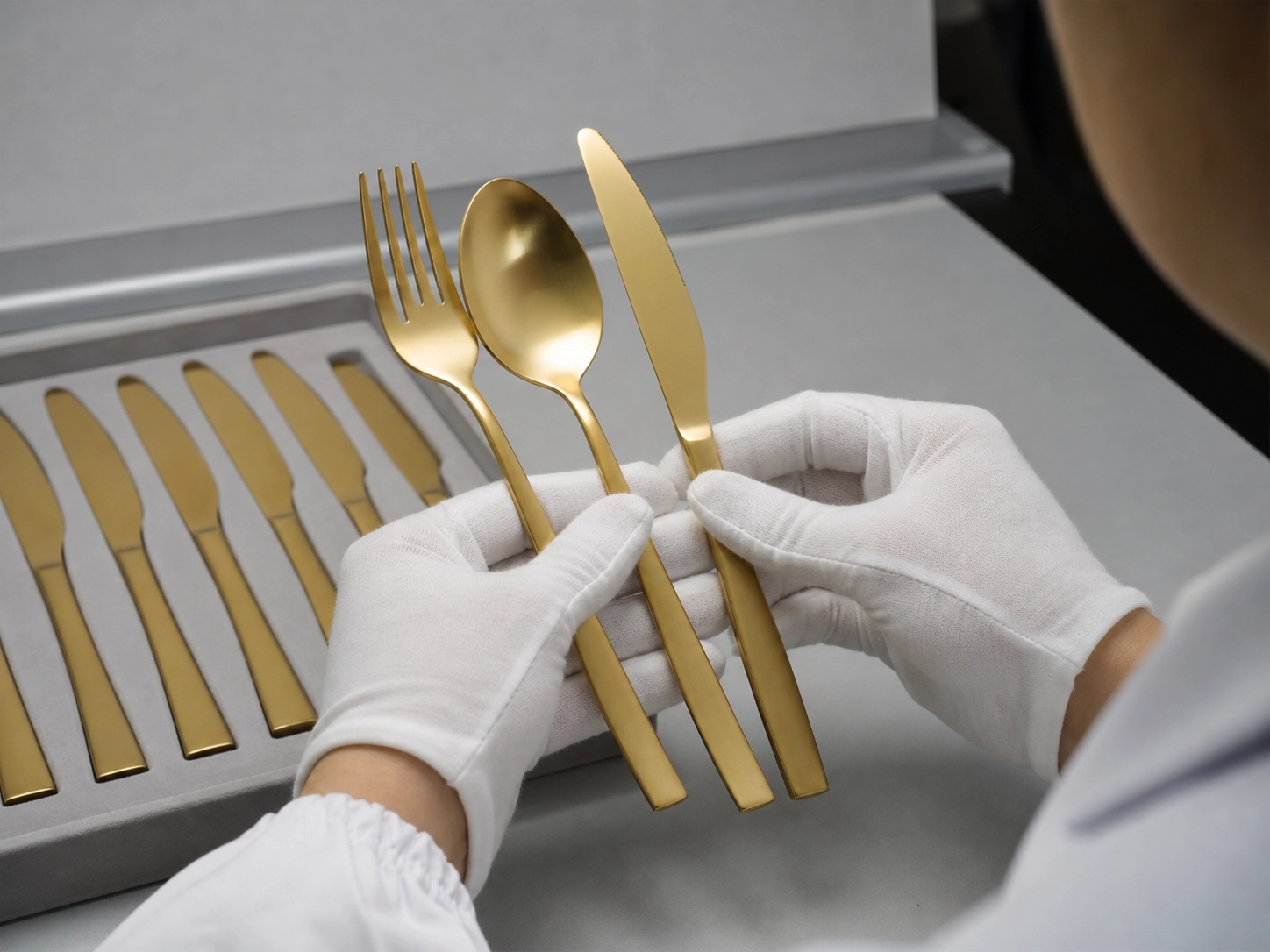
Approve Color and Performance in the Intended Conditions
- Approve the uncoated product. Confirm dimensions, weight and workmanship first.
- Review the color sample under controlled light. Compare all utensils together and record the accepted range.
- Test the real cleaning process. Use the intended detergent, temperature, water and drying conditions for a buyer-defined cycle count.
- Test handling. Evaluate stacking, sorting, tray contact and transport if the application involves rental or banquets.
- Inspect after testing. Record color shift, exposed areas, scratching, adhesion concerns, staining and roughness.
- Approve the care statement. Publish only the care claims supported by the agreed sample and test.
A general “dishwasher safe” claim is too broad unless the relevant product, detergent and wash conditions have been validated. For coated products, care language is part of the technical specification, not only a marketing statement.
Protect the Finish During Packing and Shipping
Color-finished pieces can mark each other before they reach the customer. Individual sleeves, tissue, formed trays or dividers may be needed depending on the surface and sales channel. Test the actual pack, including master-carton movement, rather than reviewing only an empty presentation box.
Confirm inner-pack quantity, carton count, net and gross weight, carton dimensions, marks and pallet requirements. Keep mass-production lead time separate from ocean, air or express transit time. Custom colors and printed packaging may also have different MOQs, so request each minimum separately.
Illustrative Application Scenario: Gold Flatware for an Event Venue
This is an application example, not a customer case. A wedding venue wants gold-tone four-piece settings that will be washed, sorted and transported between events.
| Risk | Specification response |
|---|---|
| Shade mismatch across pieces | Approve the full place setting and define the accepted color range |
| Contact marks during sorting | Run a handling trial and use separated storage where required |
| Detergent-related change | Test the venue’s actual wash chemistry before release |
| Replacement pieces look different | Keep the item code, coating specification and approved sample for reorders |
| Care instructions are ignored | Train operations staff and include a concise written process |
The venue can then compare the desired appearance with the labor and storage needed to maintain it. This is a more reliable purchasing decision than choosing by color photograph alone.
Common Gold-Finish Purchasing Mistakes
- Assuming every product described as PVD has the same performance
- Approving color from a phone or computer screen
- Testing one utensil instead of the complete set
- Ignoring the base steel and pre-coating surface quality
- Publishing dishwasher claims without a defined validation process
- Using bulk metal-to-metal packaging for a sensitive finish
- Failing to preserve an approved sample for future reorders
FAQ
Is PVD always better than electroplating?
No single process is automatically right for every product and budget. Compare the complete coating specification, base material, sample appearance, test results, care requirements, MOQ and cost.
Can gold-finish flatware be used in a commercial dishwasher?
Only make that decision after testing the selected product under the intended detergent, water, temperature and drying conditions. Follow the supplier’s approved care instructions.
How should a buyer approve gold color?
Approve a physical reference sample under agreed lighting and define acceptable variation across all pieces in the setting. Keep the sample for production inspection and reorders.
What information is needed for a gold-finish quotation?
Send the piece list, base steel target, finish direction, physical color reference, quantity, logo, packaging, test requirements, care expectations and destination.
Turn the Finish into a Controlled Specification
Review the stainless steel material guides or compare a decorative-handle flatware collection. A useful inquiry includes the application, wash process, piece mix, base material, finish reference, quantity, logo, packaging and destination.